Wednesday, July 24, 2013

Edwin Martin Currier - Interlude for Photos

When we return home from vacation I will continue posting my research on Edwin Martin Currier. My posts of parts 1 and 2 took my search up through 1894 or so.  I wanted to present my study of Edwin's life events in chronological order and I will resume doing that when I post part 3. But in the meantime I wanted to share some recent photos I made in Edwin's home town of Lowell, Mass.  My wife and I worked in a couple of days of our vacation to New England to visit Lowell and see what we could document about Edwin.

Our first stop was a visit to Edson Cemetery. I had documentation that Edwin's parents and his sister were interred there and suspected Edwin was buried with them. I had written the cemetery in March but never received a reply. I called them in May and they confirmed that Edwin's family had a plot with five Curriers interred. A sixth interment was buried in the same plot but not for any Currier family member and that interment was the first logged into the cemetery's records. Edwin is shown as the owner of the lot.


Listed chronologically by date of death, Edwin G Brown was interred in lot # 1803 in 1882.  Apparently the Curriers purchased the remaining five burial sites within the lot and so joined Mr. Brown for their final resting place in the same plot. There is no headstone or marker for Edwin Brown but the Currier family has a family monument and each family members names are engraved with year of birth and death.

The side of the headstone facing east lists Edwin's parents, James Hale Currier and Dorothy (Richardson) Currier, and his sister, Emma D. Currier.  The family name is engraved on the base of the headstone. This monument is remarkably preserved with no erosion or deterioration of any kind from what appears to be a shiny marble facing.

                                                                                   
The west side of the headstone displays the names of Edwin and his wife, Carrie Brownell.  Edwin and Carrie were married in 1895. I have documentation of this marriage at home and will include it and other docs when I get home and can resume posting the chronology of Edwin's life.  The first thing we noticed on this side of the headstone is that Edwin's year of death is not engraved. His name is the only one of the five family members that's missing death year.  According to the cemetery log for lot # 1803, Edwin passed away in 1920. I have no clue and the Edson Cemetery office had no idea either, on why the engraving on the headstone was incomplete.  According to the cemetery office records Edwin paid for perpetual service ($100) in 1901.  But the headstones and engraving thereon are a separate function from the services provided by the cemetery.  Perhaps Edwin didn't coordinate to have the work done by the time he passed away?  Edwin and his wife had no children so there was really no one else to accomplish the task.  Not to jump the gun on my pending post(s) on Edwin but when he died he was a resident of a home for "aged men" so he might have let the ball drop due to dementia or something. I guess we'll never know. When I asked the office how I might be able to have the engraving completed they referred me to a list of monument companies that could do the work. I'm waiting for a quote from one of them to see if I can coordinate completion of engraving to display Edwin's date of death.   Considering his interest in genealogy and the Currier family history, I'm sure he would have wanted the engraving to be completed.

Following our visit to Edson Cemetery we drove into the city of Lowell to photograph the places   where Edwin resided and worked. The first of these was 57 Willow Street where Edwin resided in "rear 4" with his parents and sister.


This is 57 Willow Street as it appears today. Three stories and multiple entrances hint that the basic structure may be similar or the same as it was while Edwin resided there (1868 to 1894). Exterior improvements have been made, of course, including the handicap access ramp on the left side of the building. However, as discussed in previous posts, this was the Currier family's address but not their residence. As noted above they resided in 57 Willow Street, 4 rear which was located behind the structure pictured here, probably right about where the blue dumpster is situated in the parking lot behind the house.

The next building we wanted to see was the manufacturing facility of Woods, Sherwood & Co where Edwin started his career with that company as a wire worker. The company no longer exists, at least not in Lowell. But a structure remains at 572 Bridge Street that looks similar to the elongated rectangle of the original plant shown on the maps posted in my Part 2 posting. Whether or not it is the same structure with improvements I couldn't say but it definitely is no longer a manufacturing plant but a multiple unit apartment building. 


The last  building we wanted to see was the residence Edwin shared with his wife, Carrie, and his widowed mother. I'll document their move to this last structure when I resume Part 3 but in the meantime, trust me on this, they resided at 95 Ludlum Street which was probably a shorter walk for Edwin to get to his job with Woods, Sherwood  & Co. 


The home currently has two entrances and three stories. We did not observe any other entrances on either side of the building so presumably two families live there, one on the first floor, the other on the second and perhaps the third floor.  I don't know if that arrangement was the case for Edwin or not but it wouldn't surprise me. According to the Federal Census Records for 1900 and 1910, Edwin rented the home at 95 Ludlum Street rather than owned. A savvy lessor would most likely rent out a three story building like this one to as many tenants as they could get away with. 

We finished our research of Edwin the following morning at the Pollard Memorial Library in Lowell. The library has almost a full floor dedicated to genealogical research, including microfilm newspaper copies. We found obituaries for all the Curriers except for Edwin's mother.  I was hoping also to find some info on Edwin's employer.  I had my fingers crossed I might find a group photo of the employees and the plant for Woods, Sherwood & Co., but no such luck.   The closest I came was a historical sketch published in 1897 on the leading citizens of Lowell that had a nice biography and a photo of Edward Woods, described as the "senior member" of Woods, Sherwood & Co. Since I have no way to scan any of this material away from home I won't be able to document my research until I get home to Florida. And when I do, my search will go on. 

Friday, June 14, 2013

Edwin Martin Currier - Part 2: Dismission to Lowell

In my posting of Part 1, The Letters, I explained the origins of my interest in Edwin Martin Currier.  My curiosity arose from two letters Edwin had written to a branch of the Currier family, apparently that of my mother's great grandfather, John Currier, of Langdon, New Hampshire, in which Edwin stated that he had "formed the plan of writing a genealogical record of the Curriers."  I have now  formed my own plan;  to research and construct a chronological record of Edwin Martin Currier's life as best I can and, hopefully, see whatever genealogical record Edwin was able to put together. This post,  Part 2, Dismission to Lowell, will attempt to do that.

Edwin's letters were written from his home in Lowell, Massachusetts where he resided with his parents. But since I live in Florida all of my research so far has been online.  I hope to find more source material to add to my research of Edwin's life this summer on a vacation trip to New England. But in the meantime my research has been confined to whatever I can find on the Internet.  My two primary sources of information have been the membership-only websites,  Ancestry.com and The New England Historic Genealogical Society.  Other resources will be cited to reference any other information I've been able to uncover.

                         
Ancestry.com's huge database steered me right to an extracted record of Edwin's birth, transcribed from New Hampshire, Births and Christenings Index, 1714 - 1904. I always prefer to use the original record as a source but I could not find the original index online. The man who became identified as Edwin Martin Currier was born November 5, 1844 in Pelham, NH. It appears from this transcription that he was named Martin Edwin, with the given and middle names reversed from his later identity. The indexed father's name, James H. Currier,  duplicates Edwin's lineage info in the letters to John Currier. His mother's name, "Dorothy P." in subsequent research coincided with her given name of Dorothy Page Richardson.


The September 1850 Federal Census for Pelham, NH shows another interesting twist on Edwin Martin aka Martin Edwin's name by listing him as "Martha E." and designating his gender as female. He (she) is listed along with parents, James H. Currier and Dorothy Currier, and an older brother and sister, James W. and Dorothy E.  I can only guess, but I suspect the gender confusion was caused by the enumerator simply making a transcription error when posting data on the final census record.  The record (shown below) is neat and clear of corrections of any kind, which indicates to me that it was a final transcribed compilation of census data and not a "real time" work sheet. Thus, five year old Edwin is recorded in history as a female named, Martha E. Currier.


Ten years later the Pelham Federal Census for 1860 is more accurate but not completely. At least the gender is correct with the "m" identifying him as a male. However, the age of Edwin, identified as "Martin E." is listed as 14.  Born in November of 1844, this census recorded in July of 1860 should have shown the young man to be 15 years old. Edwin aka Martin still resides with his parents but his older siblings have apparently moved on to reside elsewhere.


The ten year gap between these first two Federal Census records was the longest duration of time between recorded events of  Edwin Martin Currier. In 1868 a transcription of "Dismissions" from the Congregational Church of Pelham records Edwin's relocation to Lowell, Massachusetts. My first thought when I located this list from the William Thomas Hayes Historical Collection, on the Pelham Historical Society website was, "Oh Oh, were there dire circumstances causing Edwin's dismissal from his church?"  But after review of the form all of the names listed along with Edwin are in a column labeled "dismissed to" along with destination cities. Thus, this "dismission" list appears to be a record of church members who have moved on to different locales away from Pelham and not for any sins or transgressions the church found unsavory.

     
 Since this list is a transcription from the church's original records I'm reluctant to make assumptions about why Edwin is the only Currier listed.  Subsequent research shows that Edwin's parents also "transferred to" Lowell by 1868, proof of which I will get to shortly.  I've chosen not to guess how involved Edwin and his other family members may have been in the Congregational Church in Pelham. The transcribed records from the Pelham Historical Society website list five categories of church history including, marriages, baptisms, deaths, admissions, and dismissions. But the only other posting for the Currier family besides this one citing Edwin's move to Lowell is a record of his parent's marriage listing James H. Currier and Dorothy P. Richardson with a wedding date of 14 October 1830.  Whether omissions of additional family information is an indication of lackluster participation in church activities by the Currier family or information lost in transcription, I can't really say without being able to review the original records.  One thing is sure...Edwin and his parents (and probably his sister) relocated to Lowell, Massachusetts no later than the year 1868. Evidence of their 1868 residency in Lowell is provided by the LOWELL DIRECTORY, a city record of names of citizens and business enterprises published annually by Sampson, Davenport, & Co., of Boston, Ma.  These U.S. City Directories for Lowell and surrounding communities have provided me with a view of Edwin's life and career that generously supplement Federal Census Records that were only compiled every ten years. The City Directories providing a record of Edwin and, to a lesser degree his family, compiled thirty one years of data in the span of years from 1868 to 1919. Although not as detailed in data as the census records, the directories still provide some clues as to what Edwin's life in Lowell was about. Where he lived, in some cases where he worked, and almost always his occupation were posted in the directories. Significantly, this data was recorded in the twelve consecutive years from 1888 through 1899 which eliminates the common twenty year record gap genealogists face when researching the years between 1880 and 1900. The gap was created by the destruction of most 1890 Federal Census Records destroyed in a Washington, DC fire in 1921.  The 1868 LOWELL DIRECTORY is pictured below with Edwin and his father, James listed on page 77.


Edwin is listed as "boards" at 85 Willow Street with his occupation described as "wire worker."  His father is listed as "house" at the same address which indicates James was the primary resident while his son paid a boarding fee. I don't believe that James owned the residence because in the 1870 Federal Census there was no entry made for value of real estate. It's possible that Edwin paid his boarding fee to his father while his father paid rent to a landlord.  Females were not listed in the directories unless they were the primary resident, boarders, or widows of deceased primary residents. The next Lowell Directory available listing Edwin was the 1872 edition. Combining that information with data recorded on the 1870 Federal Census tells us a few more things about the Currier family residing in Lowell.

                                                                         
The census shows James H. Currier, age 68 listed first (and therefore head of household) with an occupation of "farm laborer."  His wife Dorothy R. is shown as 56 years old and listed with the occupation "keeping house." Their daughter, Emeline D., (like her brother, it appears she reversed her middle name with the first name recorded on the 1850 census record) is shown as 25 years old and has a job description "works in printing office." Edwin M. completes the family section in 1870, still working as a "wire worker" and is recorded as age 25.  Emeline's age is off by eight years; she should have been recorded as 34 years old. But she's not the only one listed with bogus age info because James was 62 in 1870, not 68 as recorded.  And Dorothy was actually 60 years old, not 56!   Two years later the city directory shows Edwin with what may be a promotion from wire worker to clerk. I'm assuming that could be a promotion. Moreover, the 1872 Lowell Directory lists the name of the company where Edwin works...he is a clerk at Woods, Sherwood, & Co.'s."  Edwin is still shown as a boarder (abbreviated as "bds.") at 35 Willow Street and his father, James H. still the primary house resident while continuing to work as a laborer.  The 35 Willow Street address is corroborated with Edwin's 1871 letters to John Currier of Langdon, NH wherein he closed with the same Willow Street address information.


The 1872 directory's listing of Edwin's employer was an unexpected but welcome gift to my research. According to the University of Massachusetts Lowell Center for Lowell History, city directories for Lowell residents were "arranged by name, work address, occupation, and home address." On most subsequent directories I located on Edwin, this was the content format. The name of his employer was never listed again, just the employer's address. I was curious about Edwin's work as a "wire worker" with Woods, Sherwood & Co so I tried to Google the company name. I found no listing to indicate they were still in business but Google did provide me with a good idea of the company's products with a listing of "Patents for Woods, Sherwood, & Co." that included illustrations of, what else?...wire work devices patented in the 1860's!


These illustrations of their patented wire products provides a much clearer picture of the work Edwin might have performed as a wire worker for Woods, Sherwood, & Co.  Some of the products almost appear to be woven. Whether or not Edwin's wire working was performed by hand or aided by machinery is unknown. Nevertheless, with the designation of clerk as his occupation in 1872 it seems safe to say that Edwin's work has been modified from working with wire to working with pen, pencil, and paper.


The next city directory I found listing Edwin was the 1875 edition.  This directory indicated some changes in Edwin's life. This listing conformed to the standard format:   "Currier Edwin M. clerk, 150 Bridge, b.4, rear 41 willow, Belvidere."  Edwin's father, James, is recorded as: "Currier James H. laborer, house 4, rear 41 Willow. Bel." So evidently the Curriers have moved to a different address on Willow Street and Edwin's job description continues to be that of a clerk.  The employer address for Edwin's clerk job is 150 Bridge. I wasn't sure what the "Belvidere" listing was until I found an 1879 City Atlas Map (from UMass Lowell Center) that showed Belvidere as a neighborhood within Lowell that included Willow Street.
                                                                             

I've highlighted Willow Street in yellow on the map to the left. The top right center portion of the map has an indicator showing the direction for North. The various "plates" of maps available on the UMass Lowell Center website, produced by a G.M. Hopkins Co. are oriented for street and name labeling as opposed to true North at the top of the page. Thus, according to the North indicator on this map, Willow Street is oriented slightly Northwest/Southeast.  


I zoomed in on this map to see if I could get a better idea of what the Currier family's move from 35 Willow Street to 4, rear 41 Willow entailed. These maps are quite good, expertly constructed even, and when compared to current satellite images I found them to be extraordinarily detailed and accurate. I was pleasantly surprised to see that the dwellings even included street address numbers! However, my own expertise in producing zoomed images was lacking and resulted in fuzzy blurred maps. So I took the liberty of making my own "improved" versions by darkening the dwelling outlines and street address numbers as well as property lines . And I color highlighted the two Willow Street addresses to show the relocation the Currier family underwent from 1872 (yellow) to 1875 (pink).  


I'm still amazed at how much detail the map maker was able to reconstruct. It appears that the property owner for both Currier residences was a woman named Ellen Smith. Ms Smith evidently owned a number of dwellings on the Northeast corner of a city block at the intersection of Willow Street and Chestnut Street in the Belvidere neighborhood of Lowell. With the dwelling structures pictured it appears the Currier's residence at 35 Willow Street was one of five apartments within one structure. When they moved three addresses south to "4, rear 41" their next dwelling contained two apartments with addresses of 39 and 41 Willow Street.  The map clearly depicts a second and separate structure behind the apartments fronting on Willow Street and a line on the map shows this structure also separated in two. Thus, I've concluded the rear structure cited on the directory as address "4, rear, 41" is where Edwin Currier and his family resided.

Lowell City Directories for the next nearly two decades show Edwin residing at the same address from 1875 to 1893. He was listed as a boarder in all the directories through 1888 but in 1890 was designated a "house" resident. Edwin's father, James H. didn't pass away until 1893 and was always listed with the designated "house" in the directory. Perhaps when Edwin was listed as a boarder he was paying room and board to his father. And when his own designation changed from boarder to house he was paying rent directly to the landlord?  Just one possible answer to one of many puzzles that I encountered during my research on Edwin.  From 1875 through 1893 the directories consistently (a few years omitted work address)  listed Edwin's place of work as 150 Bridge Street.  This address created  another puzzle for me. To show why, I have to jump forward to 1894 where the Lowell City Directory lists Edwin's work address as 572 Bridge Street. Starting in 1894 Edwin's work address was listed as 572 Bridge Street.  Did Edwin change employers?  Did his employer relocate the business?


A business notice from 1875 (from Historicmapworks website) lists Woods, Sherwood & Co, "Manufacturers of fine White Wire Household Goods" located at Bridge Street,  "near 7th Street."


                                                                        The 1906 map on the right (from Historicmapworks, again) shows the Woods, Sherwood Co. factory in the center of the map and just to the left of the intersection of Seventh Street and Bridge Street (the name "Bridge" not visible in this cropped image). When I viewed the 572 Bridge Street address on current Internet maps of Lowell, the facility location pictured here coincides with that address. As a matter of fact, the current satellite view even shows a rectangular structure similar in shape and size to the 1906 rendition.

I could find no correlation between the Woods, Sherwood Co. location as depicted on the maps with the 150 Bridge Street address. Current Internet map searches for the 150 Bridge Street address point to a manufacturing complex adjacent to the Merrimack River and a set of canals supporting a textile mill called "Boott Cotton Mills."  Boot was one of many textile mills that began production in Lowell in the early 1800's and continued manufacturing on into the 20th Century. I found nothing to suggest that Woods, Sherwood Co. was ever located in Boott's mill complex area.  The 1879 map below (from UMass Lowell Center website) shows the Boott Cotton Mills complex with Bridge Street forming the right side margin border. There are other businesses located inside the complex but no listing of Woods, Sherwood & Co. that I could see.


Even though Boott Cotton Mills was situated alongside Bridge Street and current Internet maps pinpoint the address of 150 Bridge Street at the eastern side of the complex, Boot's office address was listed on a 1894 city directory advertisement as being located inside the complex at "Amory Street, foot of John Street."      


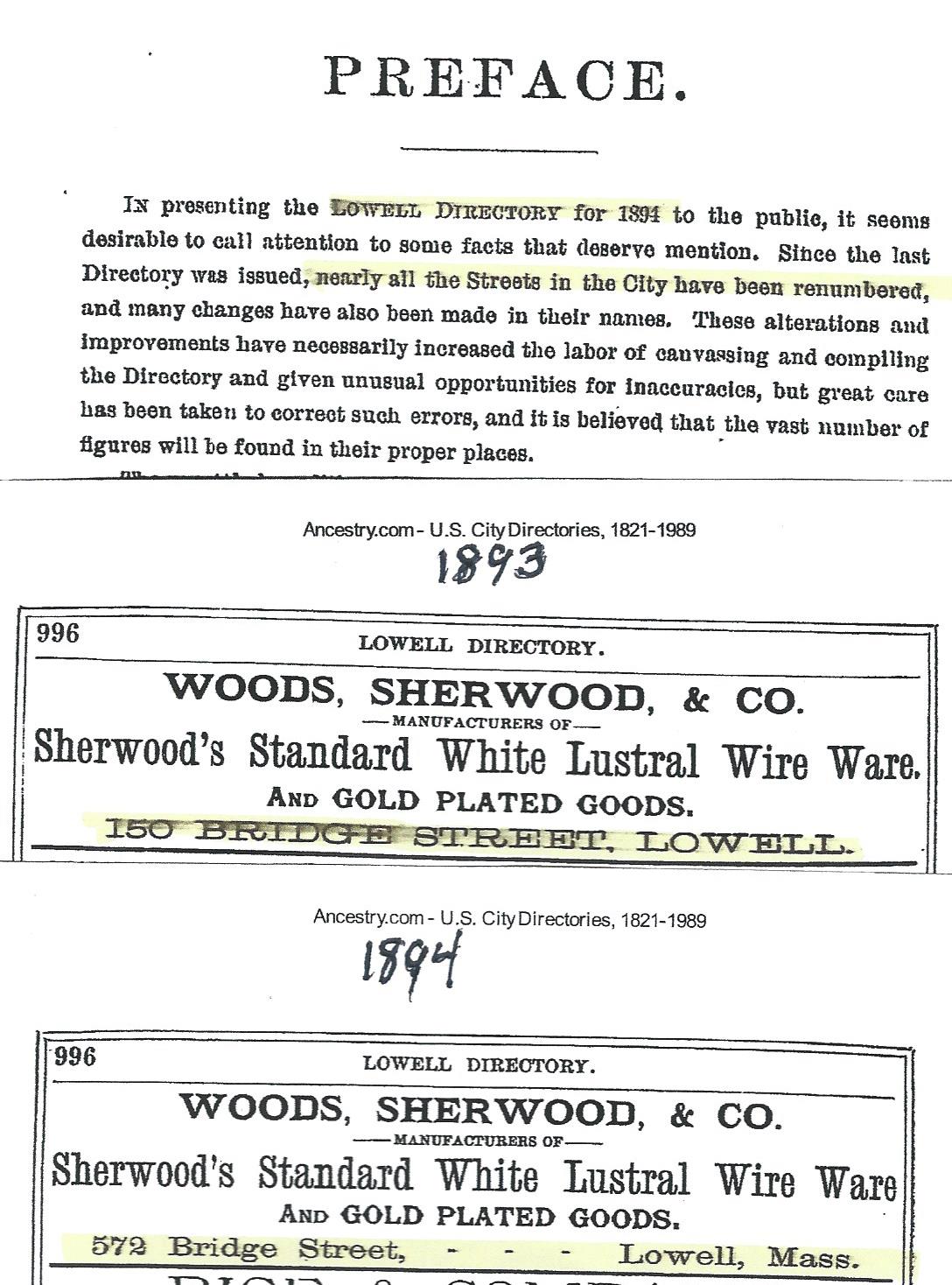
The Boott Cotton Mills advertisement in the 1894 Lowell City Directory served me as a reminder that ads usually contained addresses. Since Edwin's employer address in the 1893 directory was 150 Bridge Street and then changed to 572 Bridge Street the following year, I searched through directories for both years to see what address Woods, Sherwood & Co listed on their advertisements.  I thought that cross check would shed light on if Edwin's revised work address was accurate or not. Sure enough, their ads showed that the company's  address number in 1893 was, indeed, 150 Bridge Street while in 1894 it changed to 572 Bridge Street. Moreover, the directory editors included a "Preface" notice in the 1894 edition that explained the mystery. "Since the last Directory was issued, nearly all the Streets in the City have been renumbered."  Thus, endeth the mystery of Edwin's employer's address changes.


Edwin's workplace address is not the only change of address recorded in the 1894 issue of the directory. The renumbering adjustment also applied to Edwin's residence on Willow Street. Starting with the 1875 directory his address on Willow had been recorded as "4 rear, 41 Willow." In 1894 this was changed to "4 rear, 57 Willow. A map of Lowell from 1896 (another map from Historicalmaps website) shows the very same dwelling that used to be side by side addresses of 39 and 41 Willow has been changed to 55 and 57 Willow.  Mrs Ellen R. Smith is still displayed on the map as the property owner but her real estate ownings look to have shrunk to just one main structure plus the building situated behind the 55 and 57 Willow Street address.


The notation "4 rear" on all of the Willow Street addresses is consistently listed in the directories from 1875 to 1894, even with Lowell's house renumbering adjustment.  The delineation  of separate numbered residences located at the rear of the property facing Willow Street is made more clear by the Federal Census record of 1880.  The enumerator that  year correctly listed the numbers "2" and "4" on the census form's "Home Address" column and  clarified these entries in the "Name of Street" column by the notation, "rear of 39 & 41 Willow St."  So the structure behind the main dwelling on Willow Street has even numbers, 2 and 4 (rear) correlating to the odd numbers 39 and 41 (and, later,  55 and 57) facing Willow Street. There were four families listed as residing in 39 and 41 Willow Street, presumably (my assumption) accommodating one family on the ground floors at each address and the other families on the second floors. I know from my own history growing up in Massachusetts that many cities and towns had double and triple deck homes constructed and this was especially common in industrial areas. The Boott Cotton Mills advertisement boasted of having over 2000 employees (majority female) working in their mill,  all of whom would have needed places to live. Single factory workers typically lived in boarding houses close to the mills. But farther out from the factories multiple family homes became the norm for families to lodge with a sprinkling of individual boarders sharing living space.  Walking distance for 25 year old Charlotte Duff, for instance, who resided at 39 Willow Street with her mother and sister in 1880,  and who listed her occupation as a "milliner" would have had to walk about six tenths of a mile if she made or sold hats anywhere near the Boott Cotton Mill complex.

                                                                                     
39 and 41 Willow Street residents in 1880
                 

   The next page of the 1880 Federal Census record (shown below) accounts for residents in the "rear' dwellings on Willow Street. There are three families listed as residing within the enumerator's "2 rear" and "4 rear" designation. It's possible the dwelling structure behind the multiple story building at the front also had multiple levels that would accommodate three families.  I would also note that the 1896 map had a line drawn at the back of but still part of the 55 Willow Street apartment that could possibly have been considered "rear" for census purposes. But one way or the other, Mrs. Ellen R. Smith seems to have been quite successful, at least in 1880, in renting out the residential property she owned on Willow Street. And it also implies the Curriers were satisfied with their housing arrangement because they resided in Mrs. Smith's properties for over 25 years. Or maybe Mrs Smith just made them a deal they couldn't refuse. By the way, current Google satellite pictures of the 57 Willow Street address confirm it is now a three floor dwelling. Unfortunately for this report, the "4 rear" dwelling so intricately depicted in the maps above, no longer exists. There is now a parking lot located where the apartments behind the main structure were once located.


The "rear" residences accounted for in 1880

Along with the Currier family's housing arrangements, the 1880 Federal Census recorded some interesting changes in family members' occupations. James, no longer a "farm laborer" is now listed with the job of "gardener." His wife is still shown "keeping house." Edwin's sister, Emeline, presumably in the same printing office she reported in 1870 is now a "type setter." And Edwin is listed with the occupation of "Insurance Agent." There's no way to know if this title was bestowed in error by the enumerator or, if accurate, suggests a major career change for Edwin. Perhaps it was an experiment or a "middle-age crisis" leap for the 35 year old Edwin but it doesn't appear to have been a long lived career. The 1878 city directory had shown he was a clerk. The next available directory (1881) described him as a "packer" back at Woods, Sherwood & Co. So if the insurance agent title was accurate it apparently didn't work out and Edwin was back in the wire business, and moved on to the position of "packing" instead of "clerking." 

Whether his home address was 4 rear behind 41 Willow or 57 Willow, Edwin had a distance of just over 1 mile to travel to his work place at 150 Bridge Street.  Probably Edwin walked from home to work and back. From his home the most direct route to travel to work was to follow Willow Street north for 2 blocks and turn left onto East Merrimack Street heading west for just shy of half a mile. Adjacent to the Boott Cotton Mills complex, East Merrimack Street intersects with Bridge Street. Once on Bridge Street Edwin would have proceeded north for a half mile to reach Woods, Sherwood & Co's facility.  He would have crossed three bridges on the route, first over the Concord River, second a small bridge over the "Eastern Canal" and, finally the largest of all three that spanned the Merrimack River and in doing so lent its function to its name, Bridge Street.  The 1891 State Atlas Map below (from Historicmapworks.com) is highlighted in pink to display his assumed travel  pattern between home and work. According to the National Streetcar Museum website, early 19th-century Lowell was a "walking city." This website relates that in 1864 the Lowell Horse Railroad Company established the city's first horse-powered streetcar on a line extended from Belvidere  (Willow Street's neighborhood) into downtown Lowell.  If this was transportation Edwin utilized he might have saved himself about half a mile of walking distance because this mode of transportation went west from Belvidere toward downtown Lowell where the mills were located. And later, according to the streetcar website, "the first electric streetcar began operating in 1889 on a line running from downtown across the Merrimack River into Dracut." Bridge Street, where Edwin worked runs generally north from the Boott Cotton complex across the Merrimack River and on into Dracut, a town on the northern city line of Lowell. There's no way to know if Edwin took advantage of streetcar transportation or not.  It may well be that Edwin walked or rode a bike to work. But it's interesting to trace his steps, so to speak, and imagine how he got to work.


I recognize I have bounced around rather haphazardly describing Edwin's residence and work locations during the years 1878 to 1894. I apologize but I'm sort of a sucker for visual aids in my research and the maps of Lowell, I think, provide tremendous insight into where, and to some degree, how Edwin lived and worked in the first fifty years of his life. Only maps from the few years that I posted in this piece were available online.  That said, I will try to resume describing  my research of Edwin in a more chronological sequence of his life events. The city directories continued throughout the 1880's to list Edwin at the same address on Willow Street and with the same occupation as a packer with Woods, Sherwood & Co.  The first indication I found that Edwin was still on board with his plan of  "writing a genealogical record of the Curriers" was an entry published in his name in the Notes and Queries section of the January 1877 edition of The NEW ENGLAND Historical & Genealogical Register. Edwin's note and query is the second comment on page 114 of the January 1877 Register and is pictured below.


Edwin's note lists information regarding his 4th great grandfather, Samuel Currier (1636 - 1713) and describes Samuel's gravestone located in Haverhill, Ma. He also cites the stone inscription and laments the condition of the stone having partially sunk into the ground. I don't know if Edwin expected an answer or assistance with his plea, "It is a pity this old relic could not be set upon a granite foundation...Who will assist in the undertaking?"  Perhaps someone heeded Edwin's plea because a photo of Samuel Currier's gravestone in Pentucket Cemetery (I obtained from Ancestry.com) does not depict any leaning that I can see. I don't know when this photo was taken but it was posted to Ancestry's website in 2011.
                                                               
 But the interesting part for me was that this entry was my first evidence since Edwin's 1871 letters to my great great grandfather that he was still pursuing his family history research. Also interesting is to wonder how Edwin got to Pentucket Cemetery in Haverhill as it was located 25 to 30 miles northeast of Lowell.  There was railroad service between Lowell and Boston as well as Lowell and Andover in the mid nineteenth century but I have not researched if it might have been feasible for Edwin to reach Haverhill by train. How he arranged to travel to his ancestor's burial place will remain a mystery but I suspect he might have ridden by rail because train travel had proliferated throughout this area of the country and especially so during Edwin's adult life.

Two years later Edwin posted another query in the New England publication again, this time soliciting information about a "Henchman" or "Hinksman" surname that I'm not familiar with. I did plug the names into my Ancestry.com tree to see what I could find but nothing came up.  I could have tried the same thing on other websites but at this point I'm putting the subject to the side and perhaps will come back to it some future time. But for the time being I was gratified to see that my 2nd cousin 3 times removed was still in the research business. Without tracking down his "Hench/Hinksman" pursuit I could also relate to the possibility that Edwin's research had taken him down a path not immediately recognizable as connected to the Currier family.  But you never know until you follow a lead as far as you can if you're going to end up in a dead end.  I'm sure Edwin found this to be true because I have been there so many times I've lost count. I get interested in someone who gets married to someone whose relatives have more children and the branches just go on and on like a spider's web. Whether or not this 1889 query by Edwin was one of those endless branch searches or if he latched onto something solid I may never know. But I definitely feel a sense of brotherhood with Edwin for his family history research.

Another event in the year 1889 was not so great for the Curriers of Lowell.  Edwin's sister, Emeline died on October 20th.  The record of her passing was listed on a city record called "Deaths in the city of Lowell in 1889." Listed as "Emma" D. Currier, age 53 years, 7 months, and 23 days, address "rear 41 Willow" and born in Pelham, NH, Emeline's cause of death is recorded as "cancer."

                                                                               
I imagine the name Emma could have been a nickname of sorts for Emeline. Whatever she preferred to be called there's no doubt this was Edwin's sister, born to the same parents, James H. and Dorothy R. Currier.  Her work description on this record reads "compositor" which is simply another name for typesetter, the occupation listed on the 1880 Federal Census. Her burial is recorded as being in Edson Cemetery, lot # 1803.

Edwin's job title of "packer" had been consistently recorded as his occupation in the city directories from 1881 through 1889. In 1890 the directories changed from "packer" to describe his work as "shipping clerk." The progression of Edwin's career at Woods, Sherwood & Co. shows a trend of what appears to be increasing responsibility as he moved from wire worker to clerk, followed by packer to shipping clerk. I could be wrong but my own personal experience in transportation, albeit a century later, would classify Edwin's career progress as evidence of climbing the corporate ladder. In a very modest way perhaps, certainly a blue collar way but, nonetheless, his was an American success story.

 Even without the missing 1890 Federal Census, the next few years' City Directories showed few changes in Edwin's life as he approached his fiftieth birthday. He lived in the same house but was listed as a primary resident as the directories noted his address"house" from 1890 and on.  He worked at the same company and was listed as a shipping clerk each subsequent year. One change that did affect the Currier family was the death of Edwin's father, James Hale Currier on May 11, 1893.  Cause of death listed on "Deaths in the City of Lowell" record was "heart disease."  Dead a few months shy of his 85th birthday, James H. Currier's burial information shows he was interred with his daughter, Emeline, in lot # 1803 in Edson Cemetery in Lowell.


The following year in the 1894 edition of the Lowell City Directory we see the address change from 41 to 57 Willow Street along with a listing of Edwin and directly above his name, his mother, listed as widow of James H. Currier.  Below them and listed in alphabetical order in the Currier surname section is an entry for James H with the notation, "died May 11, 1893."  


This, then, is what we have established about the life of Edwin Martin Currier.  In 1894 Edwin will reach fifty years of age in November.  He has established himself as a working citizen of Lowell, Massachusetts. He has worked for the same employer for twenty six years, possibly uninterrupted except for a brief excursion into the world of insurance agency.  He has displayed evidence of a concern for and a curiosity about his family's genealogical history.  His family has diminished with the loss of two members, first his sister in 1889 and more recently, his father in 1893. Along with his mother he now resides in the same dwelling the Curriers have rented since 1875. And we still don't know the success, if any, of Edwin's stated goal "of writing a genealogical record of the Curriers. To this end my search goes on. 


Monday, May 13, 2013

Edwin Martin Currier - Part 1, The Letters

In my ongoing search of family history I came across two letters written in 1871 by a gentleman named Edwin Martin Currier. I found the letters inside a folder of  miscellaneous family history material I inherited from my mother.  There were no envelopes with the letters to identify the addressee.  But since my mother's maiden name was Currier and after reading the letters it was obvious that Edwin had addressed them to someone in the Currier family.  Edwin stated that he was "now writing to the various branches of the family who were descendants from Deacon Nathaniel Currier of Pelham." (Pelham is a town in New Hampshire).  Edwin went on to say, "I have formed the plan of writing a genealogical record of the Curriers."  This statement grabbed my attention right away. I was curious to find out who Edwin Currier was and, if possible, find out the results of his planned genealogy research of the Currier family.

Letter # 1 - Nov. 2nd, '71


My first step in researching the letters was to try to figure out just who Edwin Martin Currier was. I had not heard the name in my previous research of my mother's family so I didn't know if Edwin was a close relative of my mother or if, as Edwin mentioned, he was from one of "the various branches of the family"  descending from Nathaniel.  The name Nathaniel rang a bell as my grandfather, Marshall Currier, (1868 -1957) had done some family history research and even drawn up his own rendition of the Currier family tree depicting Nathaniel Currier, his great great grandfather, four branches below his own.

Currier family tree per Marshall Currier
So Edwin and my grandfather were apparently descended from Nathaniel. Just how Edwin figured in to all this was explained by Edwin's question to the addressee, "Do you remember your cousin, James H. Currier who lived in Pelham?"  And this was followed by his statement, "Well, I am his younger son, at present residing with my parents in this city." ("This city" was identified as Lowell, Mass. in the closing of the letter). Armed with these clues it wasn't too difficult a search to determine that Edwin Martin Currier, son of James Hale Currier was a great grandson of Nathaniel Currier of Pelham, NH.  I searched in Ancestry.com and discovered that Edwin was born Martin Edwin Currier in 1844 per the "New Hampshire , Births and   Christenings Index, 1714 - 1904"  and was listed as the son of a James H. Currier and a mother named Dorothy P Currier. The first and middle name switcheroo didn't surprise me as I'd seen numerous examples of the same thing in my family history research (not the least of which was my father who was born George Charles but subsequently lived his life as Charles George). Another small bump in the road during my initial investigation of Edwin was the fact that he was listed on the 1850 Federal Census for Pelham, NH as a five year old female named Martha E Currier!  Little Martha was listed along with (his/her) father, James H. Currier, mother, Dorothy, older brother, James W., and older sister, Dorothy E. Currier (who, as it turned out also reversed her first and middle name and became Emeline or Emma depending on the document concerned)! The pedigree chart for Edwin's link to Nathaniel Currier ended up looking like below:

Edwin Martin Currier - Family Tree
The ascendancy from Nathaniel Currier took separate paths by Edwin's "branch" and my grandfather's "branch" at the junction of the tree containing two brothers, both sons of Nathaniel.  Nathaniel had eleven children according to my research. His fourth child was a son named Joseph, born in 1773 in Pelham.  Joseph eventually moved to Langdon, New Hampshire (a little over 100 miles from Pelham) and raised a family there that came to include my grandfather in one branch of the Curriers. Nathaniel's ninth child, Jonathan, was born in 1787 also in Pelham.  Jonathan remained in Pelham his entire life and one of his children was Edwin's father, James Hale Currier. Thus, Edwin's branch of the Curriers started in and continued in Pelham, at least through the 1860's, eventually relocating to Lowell where Edwin's letters indicated the young man's interest in family history research.

Edwin's letter dated November 2nd, '71 wasn't bashful about asking for detailed family history that he described as "all needful information that you can get respecting the members of your father's family...names...descendants...births...deaths...dates...as much as you can."  I've tried that approach with "branches" of my family with varying degrees of success so I can empathize with Edwin's request and attention to detail. Having to do much of his research by mail was a huge endeavor so Edwin won my respect and admiration when I read his letters.  It appears his inquiry met with success as evidenced by the second letter, this one dated November 10th. In the second letter Edwin acknowledges receipt of a response to his first letter "in good time" and remarks "I am glad to learn of the interest that you take in my contemplated work."  

Letter # 2 - Nov 10th
The letter from the 10th is pretty good evidence of some fast and efficient mail service. Or at least I'm assuming it was postal service but I don't have envelopes to verify they were mailed. I'm also assuming the letters were sent to Langdon from Edwin's address in Lowell, MA. Otherwise, why would they have been saved with my grandfather's research material?  Like Pelham, the distance between Langdon and Lowell was a little over 100 miles.  Without envelope evidence and without anyone  named in the salutation except "Dear Sir" I also will have to make some assumptions regarding  who the letters were addressed to.  There were four male Curriers residing in Langdon that could be presumed to be the addressee. My grandfather, Marshall, born in 1868 would have been three years old in 1871. Another son of John Currier, John Morrison Currier, was only seven years old   at the time. So neither of the two young Curriers would have been addressees.  My grandfather's father, Austin Currier (1838 - 1902) would have been 33 years old so he's a possibility. Austin's father, John Currier (1808 - 1883) age 63 when the letters were written is also a possible addressee. Both Austin and John would have been cousins of James H. Currier, albeit John a first cousin and Austin a second cousin. Both resided in Langdon. Austin was more or less the same generation as Edwin as they were only born six years apart. But based on Edwin's comments I believe the letters were addressed to  Austin's father, John Currier. In letter # 1 Edwin asks, "Do you remember your cousin, James H. Currier who lived in Pelham?"  I think John would have more reason to remember a cousin born in the same year as he (1808) and in the same town his father was born in.  Also in letter #1 Edwin asks for information "respecting the members of your father's family."  It seems most reasonable to me that Edwin's reference to "your father's family" would be addressed to John Currier, son of  the Joseph Currier who was born in Pelham but resettled in Langdon. So, right or wrong, that's my take on who was the addressee of Edwin's letters.  I tried to carry my investigation one step further in the hopes I could corroborate my conclusions about John by looking up John Currier's diary entries for the time period in question. (I am fortunate to have inherited a number of my great great grandfather's diaries ranging from 1865 to 1883). I reviewed John's daily comments for all of November 1871 and, in case I had the year wrong, performed the same review for years 1872 through 1875.  No mention was made of any communication with Edwin Martin Currier. John's diary entries were typically a short and concise recap of each day's events.  He pretty much stuck with what I would call the three W's...work, worship, and weather.  Not a lot of flowery descriptions by a man who was probably a pretty busy fellow with a  primary occupation of operating his farm while simultaneously serving as a town selectman and Langdon's undertaker.


John Currier diary entries for Nov 4 & 5, 1871
         In the diary entries pictured above John drew two loads of wood on one day and attended two church services the following day, a Sunday. Sunday's entry capped by "bad weather."  These are typical entries.  I was hopeful there would be some sort of acknowledgement about the letters from Edwin but no such luck. Edwin's letters and John's diaries are the are the only family history related documents I've uncovered so far to aid my research about Edwin Martin Currier.  To find out more I would have to continue my search online to see what I could discover about this family history buff who preceded my own searching by nearly one and a half centuries.  I felt a kinship between Edwin and myself that went beyond him being my 2nd cousin 3 times removed.  He was a genealogy nut just like me!  I wanted to know more about him and how successful his "contemplated work" turned out. And to that end, my search goes on.

Monday, January 21, 2013

Looking For Lenora - Part 5

For the time being, this will be the final part of my research theme entitled "Looking For Lenora." (Hold the applause, please)!  I'm not saying that more data will never be forthcoming.  I imagine I can find more facts to add to the profile I've put together so far.  I'm just saying that, for now at least, I think I've developed a somewhat comprehensive profile of Lenora Webber, my maternal grandmother's oldest sister, and I think it's time to move on to other subjects.  No research like this is ever fully completed. Most attempts to reconstruct an ancestor's life are continuously works in progress. So it is in this case.  I'm going to let the file evolve into a "cold case" and let it rest on the shelf for awhile.  Unlike the cold cases in TV police dramas, this doesn't mean all the mysteries of Lenora Webber's life are unsolved.  Far from it.  It just means that whatever data has been accumulated will be put to the side for now with the hopes that I can return at some later time.  That's what happened with my research on Lenora's (and my grandmother's) youngest brother, Rollin Webber.  I returned to his profile from time to time to see if anything new had developed from my original research. And when I visited his headstone in the historic Congressional Cemetery in Washington, DC I was able to reopen my files and add information to his profile. I hope I can find similar success with Lenora's history. But for now, the data below is what I have accumulated on Lenora's life.

I will be forever indebted to my maternal grandmother, Florence Huldah (Webber) Currier, for the genealogy research she started years before I was even born.  I never knew of her interest in family history until long after she passed away and, of course, she would never know of mine. But her input along with her daughters Alice and Emma (my mother) have given me a wide base of information about our ancestors from the Webber and Currier branches of my family tree.  In some cases their simply saving newspaper clippings and guest registers has contributed a huge amount of source info that has helped my research. Included among these was my grandmother's memoirs describing her life events and feelings covering from her childhood in the 1870's up to her marriage at the age of 36 in 1905.  My initial search for Lenora was inspired by my grandmother's narrative.

Grandma Currier's memoirs started my research rolling by listing the names of her siblings and she even listed them in chronological order by date of birth. Lenora was listed first (highlighted here in yellow) as the oldest and Rollin, the youngest was the last one in her tally.

The newspaper clipping posted beneath the excerpt from the memoirs is a listing of attendees at my grandmother's silver wedding anniversary. This short article was published in 1930, twenty five years after her 1905 marriage. Lenore (sic) spelled with an "e" and listing her married name (Lebroke) and residence (North Waterford, Maine) are jumping out at me almost begging me to start filling in the blanks my grandmother handed to me on a silver platter!


The first area I wanted to look at to compare with the information in Grandma Currier's writing was the Federal Census in 1870 for the town of Oxford in Oxford County, Maine.

The enumerator completing this record appears to have thought the Webber surname was "Wilber." Or may have just not been able to spell very well. Nevertheless, Samuel Webber, age 54 is listed with his wife Delora (age 26) followed by their children Lenora (7), Samuel (5), Anna (3), and Huldah F., age 1. The youngest was my grandmother, Florence Huldah Webber but I don't know if the reversal of her first and middle names was an enumerator mistake or if she simply reversed the order at a later time. But there they were in the age order listed by the memoirs as long as we assume the "Anna" listed on the record is one and the same as the "Minnie" described by my grandmother.

The other newspaper clipping I found interesting cited an unnamed niece living in North Waterford, Maine in 1926. This article is the obituary for my grandmother's aunt, Laura Webber, who passed away at 96 years of age while living in my grandmother's home in New Hampshire. I'm pretty sure the niece to whom the cremated remains were sent would have been Lenora. Interesting wording on this if you can enlarge to read it.

My next avenue of search was to find the 1880 Federal Census for Oxford, Maine.  My grandmother was still there and still listed as "Hulda."  And Rollin, the baby of the family, has now been added to the picture at 4 months old. The father, Samuel Ames Webber is listed and not listed  but allow me to explain. The date of the census record is June 3rd. Samuel died in May. So his name is listed on the record but then a horizontal line has been drawn through it, I assume to account for the head of the household passing away.  A rather unorthodox method of recording and then updating a census record I'm thinking. Nevertheless, no sign of Lenora. Born in 1863 the seventeen year old Lenora very well might have moved out for employment or maybe even gotten married. I was unable to pin down her location in the year 1880.  So at this point I reversed my attention back to the Lenora Lebroke cited in the 1930 newspaper clipping to see if I could work backwards chronologically to find her. I did that backward search as described in "Looking For Lenora - Parts 1 to 4."  That type of detective investigation is one of the things that makes genealogy research interesting. But that doesn't mean anyone else reading this post has to follow every one of my steps and look under the same rocks I did to create a profile of Lenora. I'm just going to move on with a description of what I think we know about her life in a chronological order going forward from the 1880 Federal Census record where her name is missing from the list of the Webber family.

I cannot find a record of Lenora in 1880. Not directly anyway. But I was the fortunate recipient of information on Lenora's first husband and their child. The information came to me from another descendant of the Webber family who has her own tree on Ancestry.com.  In an exchange of seasons greetings I mentioned my current search for Lenora and my very distant and generous cousin did some legwork for me and found the name of Lenora's first husband, Austin Grover and a son, John Austin Grover born in 1881. (I'm very grateful, Carol)!!! But I can't find a record of the Grover marriage nor can I find them together on any Federal Census records. But with the birth of John Austin in 1881 I'm going to guess that Lenora and Austin were married about 1880. In the 1900 and 1910 census records I found Lenora living with her second husband and on both records, a boarder named Ernest Grover resided with them.  Ernest, as it turns out was another son of Lenora and Austin, born in 1884. I also know from the 1900 census that Lenora had birthed three children but in 1900 only two were living.  So far I have no more information on who that third child was. But even without census records or marriage records proving Lenora's first marriage to Austin Grover, I found proof of their parenthood from the marriage records of her two sons.


John Austin Grover's record of marriage to Ella Francis Stevens in 1905 is a two sided document with the reverse side notated with father and mother info on both groom and bride. John Austin is recorded as the son of Austin Grover and Lenora Webber.


Ernest Grover's record of marriage in 1920 to Nona Allen duplicates the groom parental information noted on the record of his brother fifteen years earlier. For research purposes, it's fortunate for me that these records listed the mother of both grooms by her maiden name, Webber. The same info on the brides' parents just helps expand my tree with source information.


There are no 1890 Federal Census records available to pinpoint the status of Lenora and her first husband, Austin Grover. Sadly, these records (or nearly all of them, anyway) were destroyed in a fire in Washington, DC in 1921. But there is a record of Lenora on file with the town of Albany, Maine that shows her whereabouts in 1890. It is a "Copy Of An Old Record Of A Marriage" showing Lenora's marriage, as Mrs Lenora E Grover to George W Abbott on September 27, 1890.  Not nearly as forthcoming as a census record might have been but good info nevertheless. A copy of this 1890 record was posted with my Part 4 posting on Lenora.

For the next three decades Lenora is listed on the Federal Census records residing as the wife of George W Abbott. In 1900 and 1910 they lived in Albany, Maine and George listed his occupation as farmer.  There was no entry in the occupation block of the record for Lenora, presumably proof that she maintained the housekeeping duties. On a farm those duties could be extensive for the wife of a farmer. In 1900 also residing in the home were George's mother, Beulah Abbott (a widow) and as mentioned earlier, Ernest Grover listed as a boarder. Since relationship to the head of the household was the base for occupants' description I am assuming that George never adopted Ernest. If he had done so Ernest should have been listed as a step son. Ernest was listed with the occupation of "farm hand" so perhaps the relationship of "boarder" was just the simplest way of explaining why the fifteen year old boy was residing in the home. In 1910 Ernest was still with his mother and George Abbott but Beulah was no longer with them having passed away in 1902.

In 1920 George Abbott and Lenora show up as husband and wife but by this time they have relocated to a different town, Waterford, Maine.  Moreover, both of them are recorded with occupation as "none."  This possibly could mean George had retired from farming?  And perhaps relocating was a result of poor health?  George was only 59 years old when this census was recorded in January, 1920. A farmer's life is no easy life and the work may have taken its toll on George. Whatever the circumstances for the move, George passed away that year in May.  The record of death indicates he had been a resident of Waterford for three years. And this record of his death from heart disease was noted that he had suffered from the illness for two years. That record is pictured below along with a photo of his headstone.


One thing I found interesting about this record is while the information regarding his parents' names and places of birth are filled out in detail, the form has no place to designate the name of his widow. It allows for recording "wife of" or "widow of" info but nothing to indicate spousal info except a one letter notation of married, single, widowed, or divorced.

George Abbott is buried in Hunts Corner Cemetery in Albany, Maine near his parents. There are no records that I can find to indicate that George ever had another wife besides Lenora nor did he father any children.


In my Part 3 posting of my search for Lenora I described the documents and research of Lenora Abbott's marriage to Ezra Lebroke.  This marriage, Lenora's third (and Ezra's third, too) took place on April 7, 1923.  This was the marriage certificate I attempted to obtain through a third party record service but failed because I could not document my relationship to Lenora.  Maybe I should send them a copy of this posting to prove that Lenora was my grand aunt! Their boredom would be my revenge for having doors slammed in my face during my investigation. And charging me $12.95 for a non-refundable processing fee, too!! But I probably should have been a little more patient because, as it turned out, I didn't need the document anyway. So there's no one to blame but my self. Duh. Time to move on. Which brought the research along to the Federal Census Records for 1930 and 1940. The 1930 record generated the first hint I came across suggesting multiple marriages for the Lebrokes. But other than that little avenue of interest to investigate both records were unremarkable except to provide evidence of an elderly couple residing in Waterford Town Maine. The 1940 record was the only one that gave a little more detail of location with a note in the left hand column that the households listed were on "Route 118 in N. Waterford."  In comparing the two records I'm unable to say for sure whether Lenora and Ezra lived in the same place in 1940 that they did in 1930. One question on the later record asks if they are living in the same state as 1935 and their response is that they were. But the 1930 census records Ezra's occupation as "farmer" and also indicates that they lived on a farm that they owned.  In 1940 they are recorded as being renters, not living on a farm, and Ezra has no occupation and no longer works.  Not surprising that he wouldn't be working at the age of 86 I suppose. He also shows earning no income but does have income from "other sources."  Perhaps he sold the farm he owned in 1930 and used proceeds from the sale to generate income? I have no way of knowing but will pursue at a later date with land records to see what I might be able to find.

In Part 3 I described finding Ezra's headstone on the website, Findagrave.com but no record of burial for Lenora.  That website consists of burial records and headstone photos contributed by volunteers. As a result, finding someone's burial info can sometimes be hit or miss. I kept striking out on finding anything on Lenora with all the surnames I knew she had: Webber, Grover, Abbott, and Lebroke. I visited the Webber family graveyard in Oxford, Maine a couple of years ago and photographed all the stones in the Webber section. But I never thought to look for other surnames while I was there so now I started to wonder if she was with the Webber family but interred nearby with another surname. In the meantime a surfing expedition on the website for the Grover name revealed a headstone for Lenora's son, Ernest Grover that caught my eye. And lo and behold on the very same stone was the name of Ernest's mother, Lenora E Lebroke.


Lenora is buried with her son Ernest in Woodlawn Cemetery in North Waterford, Maine.  The photo provided on the website is interesting because it appears the engraving below Ernest's name appears to have been added later than the original stone, almost as an afterthought. Lenora's year of death, 1950 is the same as that of her third husband, Ezra who died September 1st that year. I don't know if she preceded him or not.

It's clear that Lenora Webber, Grover, Abbott, Lebroke was a farmer's wife three times over as all three of her husbands were labeled as farmers on Federal Census records. With the majority of citizens living and working on farms a century ago, oftentimes couples were joined in marriage for practical considerations centered on operating the farm. We can hope they found happiness and perhaps even love in their marriages but there were never any columns for that category on the census forms. So I don't know if Lenora enjoyed happy marriages or not.  I think marriage considerations centered on utility more than on romance for most of rural America as it passed from the nineteenth into the twentieth century.  While I can only guess the emotional factors of Lenora's life I think I can make an educated guess about some parts of her character. Her marriage to Austin Grover I've estimated to have been ten years or less in duration and according to Lenora she bore three children with the man who was at least 25 years her senior.  Her marriage to George Abbott endured 30 years before he died. And her marriage to her last husband, Ezra Lebroke, lasted over twenty seven years. Happy? I don't know but the record indicates she chose the companionship of a husband over living alone. And the last two marriages both endured for many years. Her sister Florence made the same choice. Although only married once, Florence married in her mid thirties and according to her memoirs, "My last patient (she was a nurse) was an old maid and I decided then and there I would not be an old maid, so I married..." Perhaps the two sisters were of like mind when it came to matrimony. Family seems to have been important to Lenora as evidenced by her attendance at Florence's 1905 wedding in Fitchburg, Ma and her silver anniversary in Alstead, NH, both trips requiring travel close to 200 miles from Oxford County, Maine. I choose to believe Lenora was comfortable with her marriages. But that's about all I can offer regarding her personal life. 

I think I've found a photograph of Lenora.  From some family photographs of headstones located in the Webber Cemetery in Oxford, Maine I came across the one below depicting an older woman standing behind the gravestone shared by Sarah and Laura Webber. Laura Webber is the one and same Laura who died in 1926 at my grandmother's home and whose remains were sent to a niece in North Waterford, Maine. The photograph is printed with the developed date: July 12, 1940. If the woman shown here is indeed Lenora, she would have been 77 years old. Looks pretty close to me.

Webber Cemetery, Oxford, Maine - 1940
I see some features in her face that are similar to her sister, Florence, but I don't think it's my grandmother in the photo. I could be wrong but I think it's a good possibility that this was Lenora.  And with that I'm done looking for Lenora, at least for now. I've enjoyed trying to learn about her and her life. But there are lots more ancestors I want to look for.  So to that end, my search goes on.