Saturday, August 18, 2012

Heritage Trail Road Trip

At the beginning of July we searched some family cemeteries in Kentucky as described in my post, "Gone But Not Forgotten." From Kentucky we drove to New Englend where my ongoing search took us to Shelburne, Massachusetts and Langdon, New Hampshire. I had never seen the burial place of my mother's sister, my Aunt Alice.  Alice W Currier was born in Langdon, NH in 1909, three years after my mother, and is buried in Shelburne, Ma with her husband,  Donald R. Morrissey. They rest together in Arms Cemetery in Shelburne.


The entrance to Arms Cemetery and the view as we entered makes it clear that it is a well maintained and finely manicured graveyard. Like everywhere in the Northeast these days the grass is somewhat burnt up and yellowing due to drought but the large number of trees providing shade throughout the grounds allows for plenty of green grass.


The cemetery is cradled between forested hills (people from Massachusetts would call them mountains!) with a winding river on the West, a pond on the East, and the Mohawk trail running East/West on the South. It is a beautiful setting for an attractive and peaceful resting place for my Aunt Alice and Uncle Don. We visited on a hot and humid Wednesday morning and only saw two other cars visiting during the hour and a half we spent there. The cemetery has two central circles around which the headstones are arranged in semi-circular rows. 

The photo on the right shows the entrance road leading to the first circle which contains a fountain and what's called, the Arms Monument.  We drove around this circle and proceeded to the Northwest side of the cemetery where we knew the Morrissey's were buried. I had obtained the plot numbers and a map from communication with members of the Shelburne Historical Society. My search coincided with the society's efforts to catalogue and photograph all Arms Cemetery headstones for the FindaGrave website. 

Donald Morrissey and Alice Currier Morrissey rest beneath a headstone engraved with their names and years of birth and death.  The stone is in good shape as you would expect it to be after only fifteen years but did have some moss growing on the face which we cleaned with a soft sponge and water. 


This stone is placed about ten feet or so forward of another Morrissey headstone marking the burial site for Donald's parents and two sisters (one of whom died in infancy at 15 days of age) and his maternal grandmother.   Both stones share some shade from a tree next to the larger stone and since they are on the Western perimeter of the cemetery it appears they are in the sun for just a few hours in the morning followed by a longer period of shade in the afternoon and evening. That's my conclusion, anyway, and seems a valid theory to explain why the stones are surrounded by mostly green grass. 


There are other Morrissey's buried in Arms Cemetery that I have not fully researched yet. I believe they might be uncles or cousins of my Uncle Don. My uncle's grandfather, Thomas Morrissey, apparently was born in Ireland around 1846 and resided in Buckland, Ma per the 1900 Federal Census. Buckland is in the Shelburne area and is where Uncle Don was born. I have no record of where or when Thomas Morrissey died so that's more research that I will have to pursue.

Satisfied that my Aunt Alice and Uncle Don were resting in a beautiful and nicely maintained setting we departed Arms Cemetery late in the morning to look around the area a bit and grab some lunch. We had seen signs for the Bridge Of Flowers in Shelburne Falls and that sounded interesting so we made a brief tourist stop to check it out. It was very nice but hard not to notice that most of our fellow tourists were our generation or older! Guess that's what happens when we age...we have plenty of time on our hands and nothing better to do than check out tourist traps so just like sheep, we join the herd (or flock) and walk around viewing and smelling flowers.


After lunch we hopped back onto I-91 North into Vermont and then jumped East over the Connecticut River and into New Hampshire on NH-12 and NH-123. Our destination was Langdon, New Hampshire. My mother was born in Langdon and although I'm not sure, her sister (my Aunt Alice) may have been born there as well. Their father, Marshall Currier had inherited a home in Langdon when his father passed away in 1902. Langdon is only about 60 miles from Shelburne so it only took a little over an hour to reach our intended destination. Our GPS, (who we call Penelope) decided to crap out on us and went totally brain dead once we got inside New Hampshire. Fortunately, I had already printed up Google Map directions so we weren't entirely lost when Penelope suffered her dementia. Our intent was to locate the house my great grandfather, Austin Currier (1838 - 1902) had built and passed on to his son Marshall. We last saw the house in 1977 on a road trip with my mother who wanted to show us the house she was born in. She had no problem finding it despite the fact she had not seen it in several decades. I tried finding it a few years ago utilizing my world famous dead reckoning technique and found nothing. But in my own defense I had two passengers in the car with me who got nervous whenever I started to drive on unpaved roads and protested going any further into uncharted territories. My wife and sister don't have the same faith in my internal GPS that I do.

Anyway, a few months ago in anticipation of this trip to Langdon I found some old maps online depicting the town in 1892 and 1860. Although not official plat maps, the maps I found identified land owners by name in general locations. By viewing these I was able to approximate the general location of the farms owned by my great grandfather, Austin Currier and his father, John Currier. Moreover I have a copy of a letter my Aunt Alice had written to my mother in 1977 (same letter mentioned in my June post about letters) describing the approximate locations of John Currier's homestead as well as the land owned by his father, Joseph Currier.  All in Langdon and adjacent to each other. Aunt Alice's letter stated that the two oldest homesteads (John and Joseph) were "cellar holes" and she referred to the Austin Currier home as "Hillside Farm." Armed with her contributions to our search and trying to recall details of the 1977 trip with my mother we unplugged Penelope and suggested she take a nap while we forged ahead with pre-printed Google Map directions and satellite images of our objectives.


Langdon 1892 - The "A. Currier" notation is one and the same  "Hillside Farm"

Langdon 1860 - The "J Currier" notation is John Currier (Joseph died in 1854)


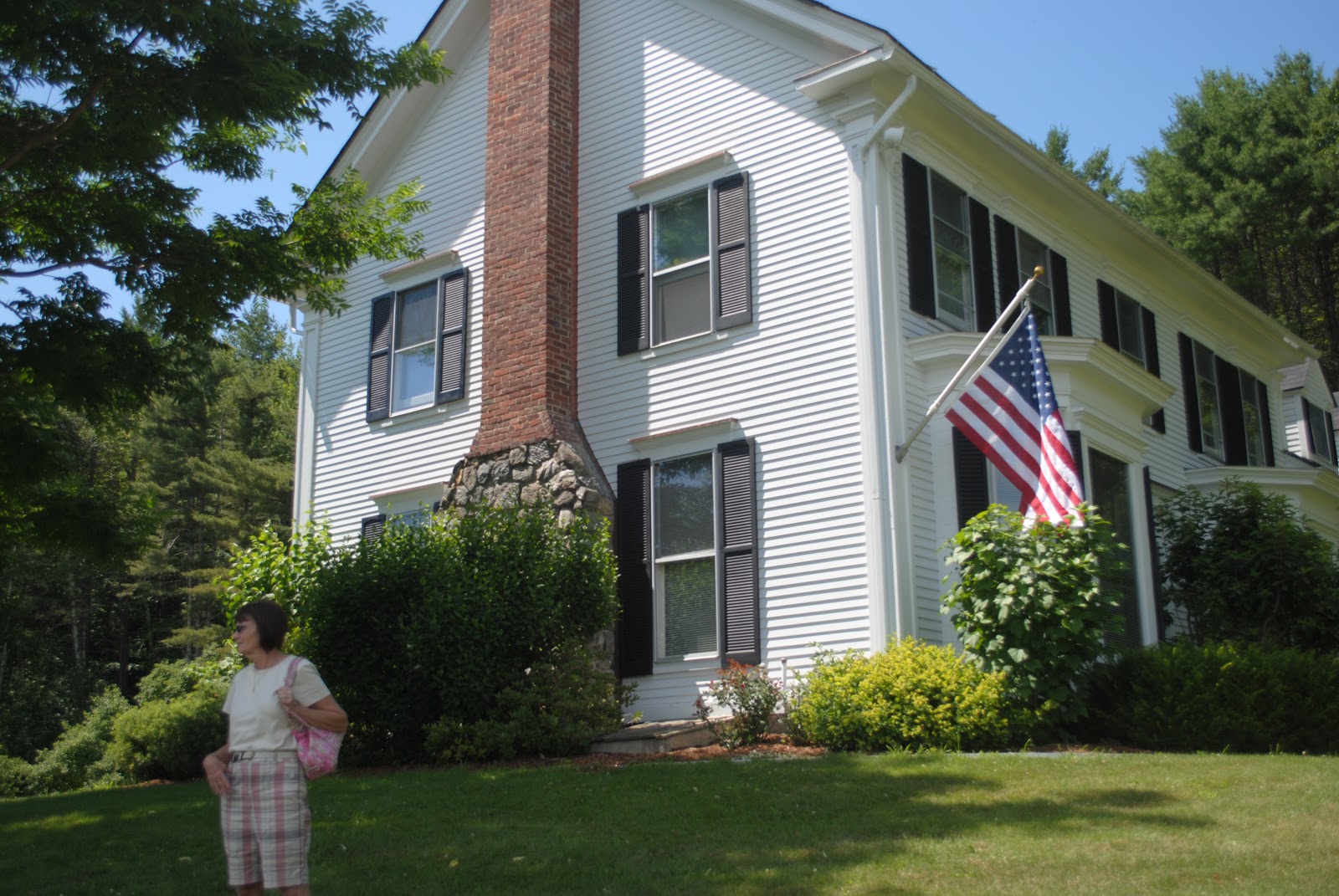
Thanks to the advance research we found Hillside Farm quite easily. It has been modified and improvements made both to the structure and the grounds since 1977 and the result is a beautiful home. It is located at the far reaches of a dead end dirt road which provides plenty of privacy. I introduced myself to the owners and explained the purpose of my unannounced visit was simply to see the house where my mother was born and asked for their permission to take photographs. They graciously approved and granted my wife and I permission to look around and take pictures as much as we wanted.


Hillside Farm


Sandi admires the views looking South from the house

A reflection pool with waterfall behind the home make a peaceful setting


Hard to see but in distant pasture was a herd of bison!


From Hillside Farm we resumed our search to see if we could locate the cellar holes of the homesteads of John Currier and Joseph Currier. Long story short...no could find. Even Aunt Alice's 1977 letter indicated their locations were largely overgrown "when we were last there" which didn't generate much optimism we'd find anything. We didn't but we gave it a good shot at least. Aunt Alice had indicated that one of the cellar holes was near "the Bascom farm."  The Bascom name is mentioned on both the 1892 and 1860 maps as located towards the north of the Curriers so we roamed around a bit in that direction when we left Hillside. Nothing jumped out at us even though some of the turns of the road looked familiar to our 1977 visit when we found and photographed what my mother thought was the cellar hole of John Currier's home.


1977 photo of a Langdon cellar hole

In the vicinity of where I thought I recalled this photo being taken we saw an attractive home with what appeared to be a good sized vegetable garden off to the side. A woman was working in the garden  so we stopped to see if she might be aware of any cellar holes in the area. We showed her some of our maps and info citing the neighboring Bascoms and Curriers and were surprised to hear that she was part of the Bascom family that has continuing farming operations in Langdon. She was familiar with the Currier name (there is a Currier Road in Langdon) but was not familiar with any cellar hole locations. She volunteered to call a relative (father, I think) and was given some suggestions of possible places to look that sounded like they were pretty far off the beaten path. Of course, most things in Langdon are far off the beaten path but while I'm not too bashful about driving around on dirt roads in the middle of nowhere for the sake of ancestry searches, I have some reservations about walking around in people's back yards which is what it sounded like our new found Bascom family friend might have been suggesting. It was very generous of her to allow us to interrupt her gardening and even make calls to assist our search. We were grateful for her attempts to help us but it was getting late in the afternoon by this time and we still had to drive back to Connecticut for the night so we thanked her and departed. She volunteered to call if she or her family came up with any more ideas of cellar hole locations so I left her my cell phone number. 

I have found in the course of researching family history that most people try to be very helpful if you ask for their assistance.  Our visit to Langdon is proof of this both from the Hillside residents and the Bascom family descendants. And while my communication with Shelburne Historical Society members was either on the phone or online, they too were willing to bend over backwards to help us with our ancestry search. If any of them read this post, please accept my gratitude for your contributions to my search. And because of people like you, my search goes on. 


Sunday, July 8, 2012

Gone But Not Forgotten

Back in October 2009, on Halloween as a matter of fact, my wife Sandi and I searched through a cemetery in the middle of massive cornfields in Herndon, Kentucky. We were assisted by my nephew Neil and his friend Richard, both of whom supplied the muscle required to cut through tree branches, wait-a-minute vines, and thick underbrush that had flourished and essentially saturated the entire graveyard where my fraternal great grandparents are buried. We found the headstones of both George King and Mary "Polly" King after extensive cutting through the vegetation. In all we identified about eleven grave markers, mostly Kings and a few other neighbors buried there. 

The local historical society named this cemetery as "McKnight Cemetery # 2" and listed all burials of record, including my grandparents and some of their children. One name listed but not found was my great grandmother's mother, Mary "Polly" Wills. (Polly was a popular nickname frequently used for females with the given name of Mary in the 1800's). So recently the four of us returned to McKnight Cemetery # 2 to see if we could find Polly's mother, Polly Wills.

The cemetery is situated among cornfields and in the center of a copse of trees. 


We never found the other Polly. According to the historical society she's there but we could not locate a stone with her name. With the temperatures rising over 100 degrees and the real threat of ticks we called the search off after an hour and a half. We did find some McKnight family headstones that are pictured below.


The McKnight stones are newer than the Kings' and, therefore, in much better shape and easier to identify. As the last family buried it appears last buried, first named is the rule for naming the graveyard. One of my Kentucky cousins tells me they've always thought of this cemetery as the King-McKnight Cemetery. But unfortunately, any King descendants in the area are too elderly to maintain the cemetery grounds. Hence, the dense foliage we found almost three years ago has returned in spades (no pun intended) and the stones we uncovered in 2009 have been reclaimed by vegetation. I didn't want to leave without saying goodbye to my great grandparents so with Neil and Richard's help clearing a path for me I was able to revisit their markers for a brief farewell prayer. 


My Kentucky cousins helped me find another family cemetery located about three miles west of McKnight #2.  One drew me a map and the other gave me more detailed directions over the phone. Both are in their late eighties, one in a nursing home, and despite their age have strong interests in genealogy and clear minds and memories. This second cemetery was referred to as "The Old Moss Cemetery." But as the photo below proves, the Kings have a claim to this burial ground right along with the Moss family.

Moderately overgrown with field grass and weeds, the Moss-King Cemetery, established 1851, is a lot easier to inventory than the McKnight. I took photos of all Moss and King stones and others as long as I could decipher the names and dates. I will try to catalogue all the interned in order to update my files on Ancestry.com and, as much as I can on the FindaGrave website.  

My grand uncle, Jacob Love King and his wife are buried here. As far as I know their marriage is where the Moss-King connection started.  Also here is the headstone for Jacob's son, George William King and his wife. George would be my 1st cousin, 1 x removed.


These stones are in pretty good shape. Partly because, like the McKnights, relatively new. George William & wife in the 1930's and Jacob & wife in 1907 (wife, Martha). Both are so similar in appearance of aging I wouldn't be surprised if both stones were engraved and mounted at the same time. I'll have to ask my cousins if they know (one of them has a stone there ready for when he passes on). The county historical society has no published record of this cemetery as there are numerous "family" cemeteries unlisted. But along with being fresher stones it appears some maintenance was performed at this site. Maybe not in recent years but only the one large tree in the center as opposed to the out of control tree growth in McKnight. I think both started around the same time period and more than likely in the middle of cornfields. 

One stone grabbed my attention with the lament engraved at the bottom of a child's grave marker. Gone But Not Forgotten. It's always sad when a child dies. In these older cemeteries I've seen a lot of children's markers, often easily identified by carvings or engravings of a lamb. If the cemeteries are untended, who is going to make sure those gone are not forgotten? Maybe genealogy nuts like me have a higher purpose than just satiating our curiosity in old graveyards. Hopefully we can help ensure those babies are not forgotten. 


Saturday, June 23, 2012

Old Letters In My Genealogy Boat

I've accumulated a few letters in the course of my family history research. Each makes it obvious I'm not the first in my family to acquire the genealogy "bug." It makes me feel better to know that I'm not the only genealogy nut in the family. Moreover, just having some of the letters has added info and hints that have made my research that much easier. The first that comes to mind is a letter my Aunt Nellie wrote to me in 1973. Aunt Nellie was 79 years old when she "felt the urge to compile information concerning our...ancestors." 


The unfortunate truth is that I don't recall receiving this letter. And while I'm in the mood to confess, I probably wouldn't have done anything with the info she compiled because I was too busy living my life with my wife and kids and working at my illustrious career, all of which were much too time consuming to allow me paying much attention to stuff about old people long dead and gone. I  discovered the letter in 1997 after my mother passed away. She had saved it and other letters and documents pertaining to the history of her side of the family. Nellie was my father's sister so my mother's compilation created an all encompassing grouping of family histories. And although I didn't start focusing on genealogy full time until I retired in 2008, my mother's apparent interest and Nellie's gathering of information are what sparked my interest in genealogy when I finally had the time to sit down and study the lives of my ancestors.


The only time I recall my mother saying anything that sounded like an interest in genealogy was in 1977 when she asked me to drive her from Massachusetts up through the area of New Hampshire where she was born and raised. She wanted to show us the house she was born in and the foundations of the farm houses that had belonged to her grandfather and great grandfather. I don't recall her mentioning the fact that she had gotten some coaching on the whereabouts of our ancestor's cellar holes but this letter from my mother's sister Alice makes it pretty clear she had some help.


Alice was definitely into genealogy.  Her letter states she was "going through the Currier history box." She also mentions her interest in knowing what condition "Hillside Farm" is in. I believe she's referring to the farm house my mother was born in. I'm not sure if Alice was born there too but the fact that she was interested in the home's condition leads me to think that's a good possibility. In any case the 1977 search was successful in finding both the farmhouse and at least one of the cellar holes. When we arrived at the house it was in beautiful condition situated in a clearing at the end of a winding dirt road and surrounded by huge trees. It appeared to be freshly painted, white with black shutters. We met the owners who had turned it into a summer home and who graciously allowed us to tour inside. My mother showed us the room designated as her nursery, having no problem locating it on the second floor over 70 years after she lived there. For some reason I never took a photo of the house. Dumb but true. I did take photos of one cellar hole. I don't recall if we found two cellar holes or just the one. I'm hoping I can go back to New Hampshire and take another look. I'm fairly certain I can find the farm house. Whether or not I'll have the same success with the cellar hole(s) is another story but I hope to give it a shot in the near future.


I treasure both of these letters. They were written by aunts that I knew and loved. I interacted with them in my life and their lives and they knew me.  Each time I read them I can hear their voices and picture them clearly. The letters are fairly "recent" documents when compared to most genealogy records my research focuses on. Often the first question I hear after confessing my interest in family research is, "how far back have you been able to trace your ancestors?" While that's an interesting issue it's not what excites me about genealogy. Admittedly it's easier to find documentation of ancestors' lives within the last 150 years or so than it is trying to go back further in history to the 18th or 17th centuries and beyond. From what research I've been able to find, record keeping virtually flourished in the 19th century, both public records and private. So  the "fishing" is better in the 19th and 20th centuries, sometimes with "fish" (clues) jumping into my boat without me having to even bait the hook! (I'm not a fisherman but the analogy seems appropriate). And to answer the standard inquiry of how far back?....James Currier (1590 - 1616) on my mother's side and Robert King (1639 - 1680) on my father's side. And that's just the Currier and King surnames. I've been able to trace my grandmothers' families back to similar time periods. My grandmother Currier was apparently bitten by the genealogy bug as evidenced by the next letter from a gentleman named Ballard Crockett in 1926. Both Ballard and my grandmother shared connection to the Webber family tree. Reading the letter reveals Mr. Crockett to be a fastidious researcher and lacking no confidence in his genealogy abilities. I have no clue what my grandmother's "letter and contents noted" he refers to in his reply letter but he obviously felt obligated to set the record straight!


Ballard was my second cousin 1 x removed. That's how Ancestry.com calculates it. And he died in 1975 at the age of 82. But our physical paths never crossed so his letter does not have the same personal connection as those of my Aunt Nellie and Aunt Alice. Nevertheless, we are obviously fellow comrades in research and the letter itself serves as testimony that my grandmother may well have belonged to the same club...genealogy nuts! I've only recently come across this letter and haven't really dug into the facts Cousin Ballard cites. But I will, in time. He may be my cousin but that doesn't mean I have to buy into the names and dates he listed without trying to corroborate with other records. 

Ballard Crockett was already in my family tree base I've constructed on the Ancestry.com website. While doing some research on the site pertaining to the Webbers I became connected with a descendant of Ballard and we have shared notes and records data for the last couple of years. But the next letter in my collection of old letters was from someone in the Currier family called Edwin Martin Currier. I had no such name in my website base. In reading the clues Edwin included in his letter to identify himself, I was able to "branch out" on my tree and find the connection. 

The date of this letter, November 2nd in what I now believe was the year 1871, was the first of two I have in the collection my mother left me.  I also believe the "Dear Sir" he addresses was my great great grandfather, John Currier. I base that on Edwin's reference to "your cousin, James H. Currier...I am his younger son." (Thank you Edwin for that statement which serves as another fish leaping out of the water into my genealogy boat)! James Hale Currier (1808 - 1893) was the son of Jonathan Currier (1787 - 1863). Johnathan was a brother, one of six, of Joseph Currier (1773 - 1854). Joseph was the father of my great great grandfather, John Currier of Langdon, NH. Joseph and his son John had homes in Langdon, remnants of which are the cellar holes my Aunt Alice described. So there's the connection. Edwin Martin Currier is another cousin!  This time, my second cousin, 3 x removed. (Ancestry.com did the math, not me). But aside from all that and the wealth of information I've been able to add to my tree is the fact that Edwin states, "I have formed the plan of writing a genealogical record of the Curriers."  TA-DAHHH !! Another genealogy nut in the family! And this guy wasn't messin' around, either! His request is the full Monty of genealogical data..."Will you be at the trouble to collect and send to me, all needful information that you can get respecting the members of your fathers family, names of all his descendants, births, deaths, marriages, etc, giving dates as much as you can, places of residence and whatever else you may think best."  

I wish I knew what my great great grandfather's response to this was. He did reply as evidenced by another letter from Edwin dated November 10th, giving thanks for the interest "you take in my contemplated work." Apparently John asked a few questions of his own that Edwin attempts to answer. And more clues swim on board with that letter, too, citing relocation of part of the Curriers to Ohio. 


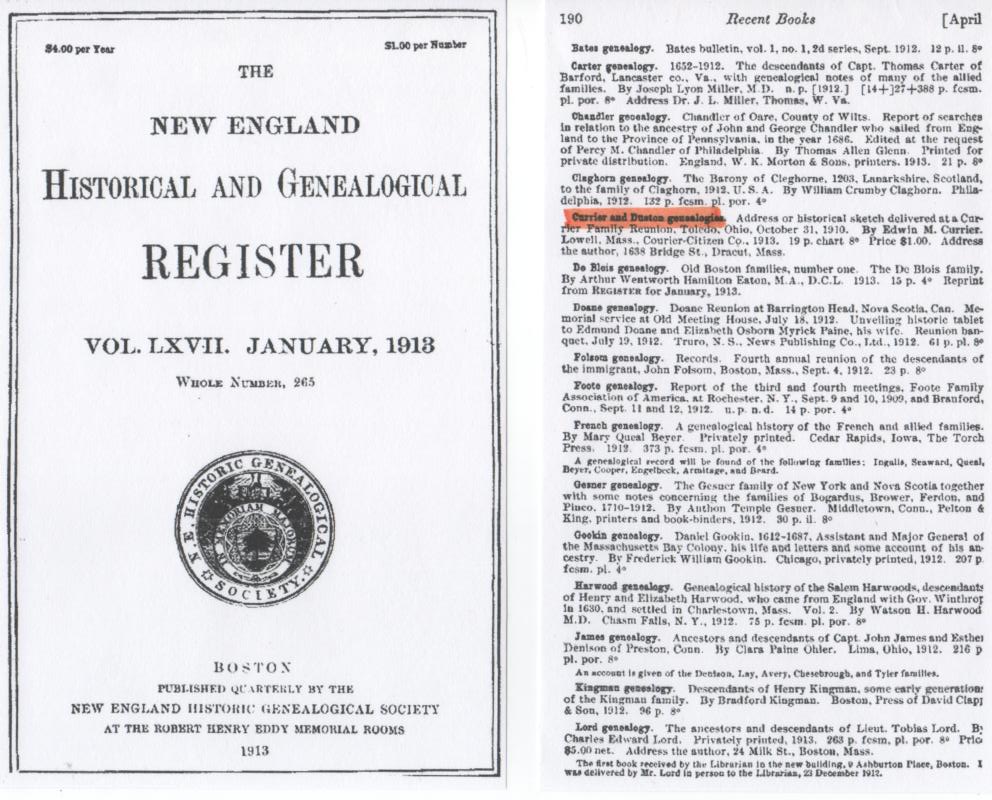
The letters are interesting and informative to work with, not to mention enjoyable to work alongside my cousin of so many years ago. Edwin and his family migrated from New Hampshire to Lowell, Massachusetts where, thanks to City Directory listings I was able to trace his life and work up to 1920 where he was listed on the Federal Census as an "inmate" at a home for aged men. Born in 1844, Edwin was 76 at the time. His occupations according the the city directories show him progressing from at first, a wire worker, briefly an insurance agent, then for many years a clerk. A brief stint as a packer was followed by many years with the job title of shipping clerk. What intrigued me most was a 1916 listing of occupation as a writer. And sure enough, I discovered that Edwin M. Currier was indeed a writer, and a published writer at that! The January 1913 edition of the New England Historical and Genealogical Register lists under "Recent Books" a publication by Edwin M. Currier of an "Address or historical sketch delivered at a Currier Family Reunion, Toledo, Ohio, October 31, 1910."  In 1913 the 19 page, 8 chart publication was selling for $1.00. There is a copy of this work at the library of the New England Historical Society in Boston but nothing available on line. As soon as I can I will be visiting the library to utilize my membership benefits to photocopy Edwin's work. 


I'm in awe of the volume of work it would take for my ancestors to compile information on their family history. Johnathan and Joseph Currier, the brothers who formed the link between the Curriers in my family and those in Edwin's were two of the eleven children of Nathaniel Currier (1741 - 1826). Edwin's "contemplated work" was a gigantic endeavor. I wonder how much and the quality of responses he was able to generate from letters to all the branches. I've also seen record of his notices in the NEH &G Register citing findings as well as inquiries over the late 1800's as he compiled his work. And all I have to do is plug in to the Internet websites that deal with genealogy. My hat's off to Edwin. I may have landed more fish in a short period of time than he could have hoped to compile in a lifetime. But you know what? He was probably a better "fisherman" than I'll ever be. Way to go, Edwin!! With your work along with Ballard's and my mother and both my Aunts Nellie and Alice, I feel inspired to keep looking...so my search goes on. 


Saturday, June 9, 2012

My Grandfather's (Sort Of) Secret Past - Epilogue

I finally received my father's high school transcripts from Lakeland High School confirming his enrollment there for four full years. This information, combined with his cousin Elgie's description of Yalaha's one room school house for grades 1 through 8 leads me to believe he attended just the two schools leading to his graduation from high school. While this doesn't prove or disprove the reason(s) Charles G King might have left Yalaha to attend high school in Lakeland, it more or less fits a pattern already established in the Yalaha home of George Johnson King and Agnes King, my paternal grandparents. Both George and Agnes indicated they could read and write according to Federal Census Records. Both of Charles' older sisters left Yalaha in 1910 to attend Massey Business College in Jacksonville, FL; Nellie was 16 years old and Carol was 19 when they left. So it appears to me that education was of some importance to the King family. Therefore, I'm standing with my original conclusion that my father's departure from his Yalaha home into his sister Nellie's Lakeland home was a move designed to continue his education that was further encouraged by the economic situation in the two homes. My grandfather appears to have struggled to keep his Yalaha citrus grove enterprise above water. He might have been hard pressed to keep his 15 year old son at home and support the expense and logistics of his attendance at Leesburg High School at least ten miles distant from Yalaha. Nellie's husband on the other hand was an up and coming businessman in his Lakeland grocery store and in a better position financially to accommodate his young brother-in-law into his home. My lingering doubts about why my father left home so early in life have been put to rest. I don't think he was running away from anything and I don't think his father, my grandfather, had any secret past that would have induced my father to leave. So, My Grandfather's (Sort Of) Secret Past is no secret at all. Just a family decision like we all have to face from time to time and, in my father's case, one that worked out well in the long run as his continued education through college and divinity school allowed him to serve his calling into the clergy.

The sort of secret past door has been closed and no skeletons were observed. But sometimes when one door is closed, another door opens. I've found this to be especially true in genealogy. A descendant of my great grandfather, William Sweet, discovered My Search Goes On blog posting about my grandfather's (sort of) secret past and contacted me. We have never communicated before and didn't know we were "cousins" until he identified himself as the great grandson of my great aunt, Elizabeth (Sweet) Henry. If you want to try to figure out what our relationship is, go right ahead, but I'm satisfied to leave it as "cousin." The photo below is from my files depicting from left to right: George Johnson King, Agnes (Sweet) King, William Sweet, Charles G King (boy standing in front), and Elizabeth (Sweet) Henry, and two more gentlemen I assume are family friends.


My new found cousin has graciously provided me with histories, anecdotes, family tree charts, and photos of the Henry family ancestors, many of whom I never knew existed, and others on which I had   some paper trails I had constructed on Ancestry.com. I've said it before and I stand by my words, when you add photographs, especially IDENTIFIED photographs to family history files it just brings those ancestors back to life. And when you add anecdotes and histories and family testimony to it all, it's like reconstructing a documentary for Frontline on PBS. Not as serious and tragic (we hope) but intriguing nevertheless.

For example, William Sweet's home in Yalaha is something I've searched for on numerous trips to Yalaha. Per my Aunt Nellie in her 1973 autobiography, "the house still stands but is not livable." I've failed to find any trace of it. It was reported (by Nellie) to have been a very impressive structure. My cousin shared a  photograph of the house taken in1946.


Please forgive the bluish hue. My copier ink is running low and I'm waiting for resupply. So now I know what it looks like. Up until now all I knew was where it was located.

Another photo posted below is a formal portrait of Elizabeth Henry's son, William Francis Henry. He was Elgie's brother so that would have made him my father's cousin. He was born in Michigan when Elizabeth Henry was married to John Levi Henry. He and Elgie were graduates of Albion College in Michigan. William later moved to Chicago where he owned and operated a "photo art studio."


There are other photos my cousin has shared with me that are now integrated into my Ancestry.com files. And there are anecdotes that I need to incorporate into the files as well. But a few delicious examples follow:

"Elizabeth Sweet was all set to marry James Henry but he died, so she settled for second best, his brother (John Levi Henry). I don't know if this caused problems with their marriage, but they eventually divorced and John Levi married 23 year old Margaret Clark when he was 49." 


"My maternal grandmother died in the 1918 flu epidemic in Chicago. So my grandfather, William Francis Henry all of a sudden had four small children, 3 boys and a girl, and no wife. He sent my aunt  and my father to Yalaha to live with their grandmother (Elizabeth by now divorced and moved to Yalaha with Elgie) and aunt Elgie. My father begged his father to be taken back to Chicago after a short stay and he relented. My aunt, however, remained there for several years. She said Elgie treated her like hired help while Elgie's daughter laid around and did nothing. My aunt Dorothy just recently died a couple of weeks shy of her 99th birthday and remained bitter her whole like about her stay in Yalaha."


"Elgie, my grandfather (William Francis Henry), father, and great grandmother were spiritualists and my great grandmother was a trance medium and used to give readings at the home in Chicago. Supposedly the spirit of William Sweet showed up at one of these meetings and all he'd say was 'Oh the wasted acres." (I'm wondering if the "wasted acres" might be the citrus grove he and my grandfather farmed in Yalaha...if the business went downhill after William Sweet passed away his spirit might have been upset about it)!

Great stuff!! Thank you cousin!!!!

So one search ends and more go on. To that end, my search goes on.


Tuesday, May 15, 2012

My Grandfather's (Sort Of) Secret Past - Part 4

This post concludes, for now, anyway, my research into the sort of secret past of my grandfather, George Johnson King (1864 - 1923). As much as I might have been apprehensive about uncovering some evidence of dysfunctional family drama, no extraordinary discoveries or dark and sinister revelations were forthcoming. Therefore, this post will not be titled, The Sins Of My Grandfather!  Neither is there conclusive evidence to reveal the nature of my father's relationship with his father. Nevertheless, I think I can make an educated guess to explain some events in their lives that have puzzled me. Specifically,  why did my father leave his home and his parents in Yalaha, Florida, move in with his sister Nellie and her family in Lakeland, Florida, and attend high school in Lakeland?  And why did my sister and I have the impression  that our father was 12 years old when his father passed away when, in fact, he was 18?  Was our father hiding something from us?  Was there some secret about George Johnson King he didn't want us to know?

                                                    DARK THEORIES ARISE

 I confess, as much as I tried to keep an open mind about what might be the answers to these questions, I had a few dark assumptions lingering in the back of my mind. First was my suspicion that my grandfather might have been an alcoholic, and as such would have made the lives of other family members uncomfortable at best and perhaps even physically threatening to his wife and my father. Part of my thinking in this scenario grew from the fact that my father strictly banned the use of  alcohol in our home. My father was a declared teetotaler. He abstained from alcohol completely.  There was no alcohol served in our home. There was no alcohol stored in our home save for some cooking wine my mother kept in the pantry. As a child when I inquired about this strict prohibition in our house I was told that my parents, specifically my father,  "just didn't like the way people acted when they drank."  I guess I've always thought that my father's aversion to alcohol originated from his career as a clergyman observing and dealing with families in his church struggling with alcohol problems. Add to that the fact that my father was reared a Southern Baptist, where alcohol in the home was forbidden, and I had a pretty logical theory drawn up in my mind as to why my father was such a strong advocate against alcohol use. So when the puzzle of our father leaving home at around the age of 15 coupled with the discovery that his father died when his son was 18 years old, not 12, an unexplained gap of our father's history, my suspicions grew that perhaps George Johnson King was an alcoholic and Charles George King relocated 80 miles away to a sibling's home simply to escape from a family made dysfunctional by alcohol abuse.  And at the same time I thought,  who knows, maybe that was why our father reversed his first and middle names...to disassociate himself from sharing the same name as an alcoholic father?

                                           DARK  THEORIES SHOT DOWN


There is evidence suggesting that alcohol was not an issue for George Johnson King. His death certificate lists the cause of death as "acute enteritis."  Although alcohol might aggravate enteritis it is unlikely to have been the cause of my grandfather's acquiring the affliction. Enteritis is an inflammation of the small intestine. Its cause is normally eating or drinking substances that are contaminated with bacteria or viruses.
If George Johnson King was drinking bath tub gin then I suppose an argument could be made that alcohol might have been a causative factor but I think it would really be a stretch to make that conclusion. I'm thinking it's more likely that he might have consumed a fair amount of citrus juices since he owned and managed a citrus grove. Because the typical small citrus grove business would have focused on fruit growing, gathering, packing, and distributing,  I don't see any reason why there would have been any extraordinary measures taken in the1920's to filter or process juice for local consumption.  Why would they? If you can pick an orange or a guava off a tree in your back yard there's not much effort required to cut the fruit open, squeeze some fresh juice into a glass, and consume a refreshing beverage! Seems to me that would have been a real easy way for bacteria to get into your system. And who knows how clean the glass was before juice was added?  Along with juice purification it should be added that water supplies in Yalaha were from wells. Who's to say a poorly located outhouse couldn't contaminate anyone's well water? Thus, there were plenty of ways for bacteria to have caused his enteritis. But another possibility is that my grandfather may have had an autoimmune condition such as Crohn's disease. I mention this because there is a history of Crohn's disease in at least one of George King's descendants.  It is much more likely that one or more of these factors caused him to suffer from enteritis, much more so than an abuse of alcohol.  Moreover, the doctor listing the cause of death indicated the duration of his patient's struggle with inflammation of his lower intestine was only 12 days. I say "only" because if alcohol had been involved I presume there would have been years of abuse involved rather than days. Unfortunately, for George Johnson King, "only" suffering for 12 days was probably like an agonizing eternity. There were few remedies of real value in 1923 and no antibiotics to cure his condition or even to ease his suffering. One last comment about alcohol I want to mention is that there were no probate records on George Johnson King in the Records Division of Lake County. So if he went on a drunken joy ride in some body's horseless carriage or if he ended up in the clinks in Tavares or Leesburg for public intoxication, he must have gotten away with it because there are no records of his being cited for any problems with the law. Nor were any articles observed in my review of copies of the local newspaper, The Leesburg Commercial, to indicate George violated any laws or disturbed anybody's peace in Yalaha. That said, the paper seemed to concentrate on "good news" and social doings of the local citizenry more than anything else (excepting Negroe crimes) and without names and categories being indexed, my review of the paper was simply a hurried scrolling review of microfilm.

                                                  WHAT'S IN A NAME

As for our father's name change wherein he reversed the order of his first and middle names to create Charles George King as his official name instead of George Charles King, I still don't know if any steps were taken to legally change his name. If so I would guess it might have been coordinated by his oldest sister, Carol, who worked in a law office in Orlando for many years. It could just as easily have been the case that there were no official steps taken and he just started considering himself a Charles rather than a George. His parents obviously named him George Charles King. He was recorded on the 1910 and 1920 Federal Census records in Yalaha as "Geo C. (King)." Since George Johnson King was the census enumerator for both of those years I have always assumed he thought of his son as George. But that doesn't mean he called his son George. I suspect from the time he was a boy, my father was tagged by family members and friends as "Charles." Every photograph taken of my father in Florida from 1905 to 1928 and when someone was kind enough to identify the subjects (I believe his sister, Nellie, was the identifier on most) refers to him as Charles. And the final proof that everyone called my father Charles comes from his cousin, Elgie, who was a bit of a historian about Yalaha wherein she cited an article in The Leesburg Commercial dated 1927 where my father's participation in a flag raising program at his school recorded him as "Charles King."  He was twelve years old at the time.
Elgie's research - Nov 1953
 If the October 26, 1917 edition of The Leesburg Commercial was on that microfilm roll I scrolled through a week or so ago I sure missed it. But even second hand transcription is good enough for me. I think my father was always referred to as Charles. Whether or not he ever officially changed his name I just don't know. Elgie Henry who wrote this article about the school house in Yalaha apparently wrote this history in 1953 according to the hand written notes at the bottom of the page. Born in Michigan in 1883, Elgie moved to Yalaha somewhere around the time that her cousin, Charles King, moved out. In 1920 she was listed as residing in the Yalaha home of her mother, Elizabeth, who had inherited the home of her father, William Sweet, my father's paternal grandfather (and George Johnson King's father in law/business partner in The Sweet King "Three Pines" Grove.)  So my ancestors had a pretty good lock on ruling old Yalaha. Elgie stayed and died in Yalaha in 1970 at the age of 86.                                      


                                             SOLVING THE PUZZLE (Sort Of)


The only question still up in the air is when did my father leave Yalaha? My guess is that it was in 1920. I base that first on the Orlando 1920 Federal Census that listed him residing with his oldest sister, Carol, and her husband, Stephen White. And second, I have Lakeland High School yearbook evidence that he attended school there for his sophomore through senior year and graduated in 1924. I'm missing documentation of where he might have attended school for his high school freshman year, school year 1920 - 1921 but I don't think he stayed in Yalaha.  If he had remained there and attended high school he would have gone to Leesburg High School. Thinking it more likely he went to Lakeland High I sent a request to Polk County School Records with a formal request for Charles King's student records, including a copy of my birth certificate per their instructions. But recently the county called me to advise they also need my father's death certificate before they can release any info. So that inquiry is still in the works. If I can verify his whereabouts for his freshman year of high school in either Orlando or Lakeland I think I can pin down his departure from Yalaha. If Orlando, he would have been living in the home of his sister Carol. If Lakeland, he would have been living with his other sister, Nellie.  Until further evidence comes in, I'm guessing Lakeland. Thanks to Elgie's research contributing the fact that the Yalaha school house only taught students through the 8th grade, we can be pretty sure he would have moved on to a high school somewhere.Regardless of when our father left Yalaha, it probably doesn't contribute in any significant way as to why. And in a word, I think the answer to our father's departure from Yalaha was...

                                                           ECONOMICS !


Upon his death in 1923, George Johnson King, "General Dealer" of the SWEET KING "THREE PINES' GROVE left his heirs a bank account with a balance of $14.27.  I'm not qualified to judge the competency of my grandfather's business acumen. But for whatever reasons, I don't think the citrus grove with his name and his wife's maiden name on it was a very prosperous enterprise. Not in the last few years of his life, anyway. He and his wife could read and write according to the census records but I don't know the extent of their educations. Regardless, their family appears to have had a vested interest in their children's educations with Carol becoming a stenographer in a law office and Nellie attending business college in Jacksonville and working as a secretary for various firms in Lakeland. Eventually the sisters' young brother Charles graduated from high school and college in Lakeland and continued his studies at the graduate level at Yale Divinity. It appears to me there was a healthy desire for education in George Johnson King's home. But I don't believe his father could have funded Charles' education from citrus grove earnings.  I do think he was assisted, if not fully supported in his education expenses by his sister Nellie's husband.  In 1915 Nellie had married Alonzo "Lonnie" Wright who had started a career at 16 years of age as a bicycle delivery boy for a Lakeland grocery store. In 1913 when he was 22 years old Lonnie was made manager of the grocery store and in 1920 he took over ownership. I think Charles King must have shown some promise as a student early on in his life and recognizing this, his family encouraged his moving to his sister's home where the economic situation made pursuing his education a whole lot more doable. I know he was not idle in Lakeland for he was expected to contribute to Nellie's family by baby sitting her three children as well as working in Lonnie's store. Charles King always spoke highly of our "Uncle Lonnie" and I'm sure his admiration of his brother in law was not only respect for his business success but also gratitude for his generosity.

Charles King (in center, wearing glasses) in Lonnie's grocery store
 
                                                    NO SECRET AFTER ALL
                           
My conclusion is that George Johnson King's (Sort Of) secret past was really no secret at all. My curiosity and suspicions were probably just my imagination trying to fill the informational blank spaces that are unavoidable when researching events that took place a hundred years ago. Assuming he was like the rest of us, stumbling along as best we can in this world,  he very well may have had a secret or two that he chose not to share. Or if he did share secrets with someone, he chose that someone wisely because it appears any secrets he may have had have remained under wraps for posterity. I've uncovered some interesting information on George Johnson King (interesting to me, anyway) in my search of his sort of secret past and if I came up short on finding anything scandalous or intriguing then so be it. I've enjoyed looking back on small bits and pieces of his life and my father's life. My research has made it obvious to me that despite any secrets or shortcomings of any kind that George Johnson King may have had, he did one thing right...he raised three industrious and compassionate children including one heck of a great son. That's something anyone should be proud of and I just hope in the short span of his 59 years of life he understood what a good job he had done.

Thursday, May 10, 2012

My Grandfather's (Sort Of) Secret Past - Part 3

The Sort Of Secret Past theme revolves around unanswered questions about when and why my father left his home in Yalaha, Florida somewhere around 1920 to live with a sister in Lakeland. My sister and I had the impression that our father's father, George Johnson King, had passed away when our father was around twelve years of age. Long after our father's death in 1971, however, we became aware that George Johnson King had passed away when his son was eighteen years old.  Moreover, our father had lived away from his parents and his birth town of Yalaha (originally called Bloomfield) for at least three years prior to his father's death and possibly longer. I realize this is an earth shattering news breaking mystery suitable for NBC's DATELINE, especially when combined with our impression that our father just didn't tell us much about George Johnson King, almost as if there were secrets about his father he didn't want revealed. So all together, the information we do have combined with the information we don't have has created an intriguing puzzle. I've been working on solving this puzzle for some time now but haven't come up with any definite conclusions.

                                                        ROAD TRIP
Last week my wife and I had the opportunity to get away from the house for a day so we travelled up to Florida's Lake County to revisit Yalaha and use some of that county's historical resources to help solve the puzzle. Lake County has a records division in the county seat, the city of Tavares. They have records dating from 1887 on microfilm including land deeds, probate records, and tons of other documents, enough to make a genealogist, albeit an amateur genealogist like me drool!  With the assistance of a very cordial and helpful staff we were able to gather and photocopy 15 pages of documents pertaining to George Johnson King; specifically his will and all of the correspondence and notarized documents required for his widow, Agnes Ellen (Sweet) King to be legally established as the executrix of her late husband's estate. Agnes was "assisted" in all this by her oldest daughter, Carol Elizabeth (King) White, who had developed a thorough knowledge of legal matters in her employment in a lawyer's office in Orlando. She also served as a Florida Notary Public so was able to assist her mother in that regard as well on the numerous documents requiring notarization.


I previously had obtained records of land purchases made by George Johnson King as well as his father in law, William Sweet, father of our grandmother, Agnes (Sweet) King. A few of the land purchases by William Sweet were subsequently resold to his two daughters, Elizabeth (Sweet) Henry and my grandmother,  Agnes King for $1, even after Agnes had married George (they married in 1890). I can't think of why that would be unless possibly William didn't like his son in law?  Who knows? Maybe I'm reaching too far for conspiracy-type answers to the puzzle but it does seem kind of strange. Then again, maybe it was some kind of legal thing or family tradition. William and George must have gotten along with each other at least a little because George became the manager of The Sweet King "Three Pines" Grove with the title of General Dealer on their letter head stationary. Together, William and George had purchased well over 100 acres of land in Bloomfield between 1888 and 1915 with small portions utilized for homes while the remainder  (I assume) was the grove where "Guavas a Specialty" were grown.

This photocopy appears to be an order form
                                               
I don't know when the Sweet King Grove enterprise started up but estimate around the early 1900's. One of my father's sisters, Nellie (King) Wright had indicated that her father had opened a general store in Bloomfield but after an unspecified period of time the business failed because George Johnson King "extended credit too freely." George's first recorded land purchases in Bloomfield were in 1905 even though he arrived in Bloomfield in 1885.  William Sweet, on the other hand (and who, by the way, had operated a successful general store business in Michigan) came to Bloomfield in 1888 and started purchasing land right away. William is listed as a "farmer" on the 1900 and 1910 Federal Census records while George is listed in 1900 with the occupation of "mail carrier" and in 1910 as "general farmer." In 1920 George listed his occupation as "farmer" on a fruit farm and listed himself as the "employer" of the business (as opposed to worker or working on account). William Sweet died in 1918 so if indeed, The Sweet King Grove was a joint venture, George appears to have assumed the position of head cheese, on paper at least.  But five years following his father in law's death, George Johnson King died.  I can only guess at his business acumen in the fruit farm realm but as his daughter Carol noted in her letter to a Lake County judge handling George King's estate, "my father left no cash on hand to speak of."  Actually, that was not true. George Johnson King left a cash account in the First National Bank of Leesburg, Fl with funds totaling $14.27. So I guess I'd have to agree with my Aunt Carol's assessment of "no cash to speak of."  In a will drawn up in 1920 George left his estate to his widow. In addition to the bank funds, the estate consisted of land that Agnes King subsequently sold off in the 1920's mostly to large citrus grove conglomerates. So after his death, The Sweet King "Three Pines" Groves offering "Choice Florida Fruits" and where "Guavas (were) A Specialty" was pretty much swallowed up by the big growers. Our search at the Lake County Records Division included a search for any probate records. I had assumed any legal matters with the business would have been there but there was nothing listed under the names of George, William, Agnes, or the citrus farm names, Sweet King and Three Pines Groves.

Right after our search in Tavares my wife and I headed over to the public library in Leesburg, about 10 miles West of the Records Division office. We had been told by more than one source that of the twenty or so libraries in Lake County, the Leesburg and Clermont branches had the best genealogy sections. Leesburg was closest so that's where we went. I concentrated my search on the microfilm files of the local newspaper, the Leesburg Commercial. They only had one roll of film covering editions from the 1880's up to 1927. From thereon out the microfilm collection was extensive but too late for the time period of my search; from the time George Johnson King arrived in Bloomfield, 1885, to his death in 1923. The one roll I was able to view was pretty spotty with some years including only a few editions and other years nothing at all.  I started targeting dates of death for George Johnson King and William Sweet but there were no copies of editions published those days. I was able to pull up pages a few weeks to a month from their death dates but no mentioning of either came up. The newspaper did not appear to have a general obituary section.  Rather, the only death notices I observed were either for prominent state or national citizens or, locally, victims of crimes. Frequently I saw articles about "Negro" crimes and punishments. These served as a reminder to me that up until the 1960's and 1970's, Florida and Lake County in particular were hot beds of extreme racial hatred and violence perpetuated by Jim Crow tactics to keep "Negroes and other undesirables" in their place.  It makes me wonder if my ancestors might have been more than casual bystanders in racial hatred.  I sure hope not. But somebody had to pick the choice Florida fruits off the citrus trees in my grandfather's citrus groves and more than likely it was cheap black labor. Anyway, another theme I noticed in the Leesburg Commercial was frequent articles on agriculture education, especially pertaining to citrus. Articles describing agriculture diseases and remedies and techniques for productive fruit farming were sometimes even the headlines and front page news. And as predominant as the articles were, advertisements by vendors who could provide the fertilizers and tools necessary to operate a successful farming business were posted on almost every page of the Leesburg Commercial. Agriculture was big news and of big importance in Lake County, Florida.   But, again, I found nothing directly mentioning my grandfather nor his father in law. Except this:


The Leesburg Commercial, Friday March 13, 1896
This poor quality edition published in 1896 seems to be a complimentary description of George J. King and is largely illegible but I was able to find it in a section of the paper listing short blurbs about local businesses. As best as I can decipher it says,

"Geo J. King, one of Bloomfield's stirring and progressive citizens, - - - - - on business Tuesday."
That's the best I can make of it and I'm not sure of the accuracy. The rectangular dark spots appear to be scotch tape type repairs to torn newsprint that might have been a good idea at the time but were not compatible with microfilming.


The microfilm records of the newspaper are not indexed in any way so unless you have a specific date in mind when you're searching and if the paper was kind enough to write about your object of interest, the only thing you can do is scroll through and hope your eyes catch something. The only other thing I found of interest was a 1913 section on Bloomfield that listed two items of interest.


The Leesburg Commercial, August 8, 1913


Much more legible, these stated:

"Miss Carol E. King of legal fame, of Orlando, is home on a vacation."


                       and


"Mrs Geo. King and daughter, visited the merchants of Leesburg Wednesday."


I'm not sure what the "legal fame" comment is about on Carol King but I have no doubt it pertains to George and Agnes King's oldest daughter, Carol Elizabeth King, born in 1891 in Bloomfield. Her sister, Nellie Irene King, born in 1894 wrote an autobiography that included the statement, "In July of 1911 I came to Lakeland, Florida, where my sister, Carol Elizabeth King had preceded me by several months."  Nellie ended up living the remainder of her life in Lakeland and raised a family there. Carol ended up living in Orlando with her husband, perhaps as early as 1913 the year of the article but at least by her 1920 listing on the Federal Census. On both the 1920 and 1930 Federal Census records Carol's occupation is listed as "stenographer in law office" so I guess that's why the newspaper cited her for possessing "legal fame."  Nellie married in 1915 and Carol married in 1917. So the daughter who "visited the merchants of Leesburg" with her mother in 1913 could have been either one of two girls.

No road trip to a records office and a genealogy section of the library would be complete without looking at the land our ancestors walked on. From Leesburg we drove South on US 27 and cut over the short distance to Yalaha. We drove up and down a few times on Bloomfield Avenue which was the main drag through town when my ancestors lived there and now one of three main drags running North and South through the area. Most of the East and West connecting roads that linked Bloomfield Ave to the other two, Yalaha Road and Guava Street,  have disappeared into wild vegetation and farm land. My Aunt Nellie, the younger of my father's two sisters has been my inspiration to get involved with genealogy. In 1973 she wrote her autobiography in about a 7 page outline of her parent's ancestors and her husband's as well. And she left the awesome gift of a hand drawn map and narrative of her memories of the houses in Bloomfield.

The "start/end" dotted lines and numbers are my description of searches I have made in the past on separate occasions with my wife, my son, and my daughter. Aunt Nellie had written in 1973 that the home of William Sweet was still standing but not livable. Highlighted in yellow (by me) on Nellie's map, we have never been able to find any remnants of William Sweet's home nor any other structures that would have belonged to my ancestors. There are some homes along Bloomfield Avenue but all probably built in the last 50 or 60 years or later. Behind most of the Bloomfield Avenue homes, roughly within the rectangle designated by points 1, 2, 6, and 4 there is dense vegetation and older trees which I have been advised is prime territory for rattlesnakes. I have not and will not be strolling anytime soon through this territory, no matter how strong the urge to walk where my ancestors walked.
Our last stop of the day before heading home was at the Yalaha Bloomfield Cemetery located on Guava Street, two blocks East of Bloomfield Avenue. To check the condition of the cemetery grounds and pay our respects to my grandparents, George and Agnes King, my great grandparents, William and Agnes Sweet, and my grand aunt Elizabeth (Sweet) Henry. Also buried in the same plot are Elizabeth's daughter Elgie and Elgie's daughter in law, Ruby. Elizabeth, Elgie, and Ruby all had the same luck in their marriages, as in not much luck at all so their ex-husbands are buried elsewhere in parts unknown. So basically William Sweet and his wife, Agnes (Montgomery) Sweet are buried with their two daughters and extended family.


I anticipate wrapping up this saga of my grandfather's sort of secret past in my next posting, which will be the same title, Part 4. My search goes on but I need to draw some conclusions about the "secret" and get on with it. I will never be able to conclusively prove anything resembling a skeleton in my grandfather's or my father's closets but I am beginning to formulate a picture in my mind of what transpired when my father left home to attend school away from his father. My search always goes on but I'll try to recap my conclusions on the matter in Part 4. Soon, I hope.